Waiting for Justice

This morning I am waiting with bated breath the verdict in the Michael Dunn murder trial.

It is day three of this so-called “loud music” trial. I am so afraid the jury will bring back a verdict of “not guilty” or that there will be a hung jury.

I am afraid because in so many cases of black people being shot and killed by white people – police or civilians – the verdict is “not guilty.” And each and every time one of those verdicts come down the pike, my heart sinks.

It seems and feels like that, no matter what, there is seldom justice for black people, especially in cases where a white person has killed or injured a black person.

What in the world is it? I remember feeling optimistic way back when Rodney King was beaten by police. It was caught on video tape…and I thought it was clear as day that that young man had been wronged, beaten cruelly and mercilessly by police who seemed totally out of control. He was treated like a sick and dangerous animal, not a man who had made a bad move.

But not even the video tape helped. The police officers were acquitted …and a city went nuts. I understood why.

America’s lack of willingness to extend justice to African-American families which have been changed forever because of violence waged against their loved ones is a dangerous and troubling thing. American jurists, too many of whom are white when it comes to delivering verdicts in cases like this – seem to subliminally think that if a black person is shot down by a police officer or by a civilian, he or she somehow deserved it. It boggles the mind, or my mind, still, that George Zimmerman is free. It boggles my mind that the police officer who shot Henry Glover was convicted …only to be later acquitted in a new trial.

Michael Dunn shot into an SUV and killed an unarmed teen. He then drove away – miles away – and didn’t even bother to call police. He shot because he got angry with a teen who dared challenge him when he asked the teens to turn their music down. He gave the classic line used in these types of cases, “I was in fear for my life.”

Bull.

This man was wrong. Jordan Davis, the kid he killed, perhaps should have kept his mouth shut …but being mouthy is NOT  a reason to be gunned down like a rabid dog.

I don’t understand why everyone cannot understand that.

I keep thinking of Langston Hughes’ poem, “A Dream Deferred.” He asks what happens when a dream is deferred?:

What happens to a dream deferred?

Does it dry up like a raisin in the sun?

Or fester like a sore, and then run?

Does it stink like rotten meat?

Or crust and sugar over

like a syrupy sweet?

Maybe it just sags

like a heavy load.

Or does it explode?

African-Americans keep dreaming for justice in this land, but it really does feel like a dream deferred.

What will happen if Dunn is acquitted? I shudder to think of the brutal slap to African-American souls if that is the reality. Another dream, another moment of hope, dashed …another dream deferred.

It just cannot keep happening. I am afraid of what this jury will decide.

A candid observation .
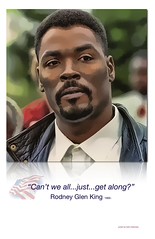
Rodney King: American Legend?

Rodney King poster
Rodney King poster (Photo credit: MarkGregory007)

An American legend has died.

Some may disagree with me, but how can Rodney King be called anything less than a legend?

When King’s horrific beating by police officers was caught on tape and publicized, I remember feeling a glimmer of hope. All along there had been cries of police brutality in the African-American community, but nobody would listen. The prevailing thought seemed to be that black people were just …bad people…and the good officers were only doing their jobs with  a people who had to be tamed.

No matter how loud the groundswell was from any particular community about what police were doing, nobody would listen. There seemed to be a “gentleman’s agreement” that what police did in black communities would remain in black communities, cries of injustice and excessive violence notwithstanding.

It made the black community feel invisible.

But with the video of King’s beating …I, and, I am sure, many others, felt like a just society would see. A justice system interested in justice would see; police departments all over the country would see; American citizens who were all too eager to write the black community off as troublemakers would see.

That belief spawned hope. Now it wouldn’t be “our” word against “theirs.” In a land where it was promised that there would be “liberty and justice for all,” justice would now come to the white officers who were caught on tape.

That was wishful thinking, however, and it really should be no surprise that after the officers were acquitted that there was a backlash. If it was that not even a video which showed what African-Americans had talked about for so long that would shake the foundations of excessive force so often used by police on African-Americans, then what would work?

King’s beating represented a raisin in the sun, a raisin of hope which exploded in a thousand fragments as that hope was dashed.

King didn’t set out to become a legend, but what happened to him thrust the issue of police violence, police brutality, into the spotlight. He became a legend by default. What happened to him, and how the justice system really ignored what was on that tape, became fodder for those whose social justice focus is police brutality. I am not quite sure how much progress has been made, but for certain, the awareness of what happens on the streets with too many citizens and police officers was heightened by King’s unfortunate experience.

Lots has been said about King’s demons. He never did really get his life under control if media accounts are to be believed. Drugs and alcohol were constant companions, and he was able to squander millions of dollars awarded to him after his beating. Everyone knows about that.

But what we may not know, or may not want to admit, is that King is a part of the American fabric, a thread in the cloth that nobody wanted in the cloth, most especially powers that be that have a vested interest in protecting the status quo.

King’s beating, and the subsequent acquittal of those officers, made a dent in a long-sanctioned system of police brutality, and that really does make him a legend.

A candid observation …