Trayvon Martin Case: Holding My Breath

Today, the special prosecutor in the Trayvon Martin case said that she will not send the case to the grand jury.

That means, at the least, that George Zimmerman will not be charged with first degree murder.

It does not mean that he will not go to trial. He can still be charged with manslaughter or second degree murder.

My prayer is that he is charged with something. In spite of  Florida’s “stand your ground” law, this case has given off a putrid odor of injustice, an odor which is not foreign to African-Americans in this country. I shudder to think of how the nation might react if Zimmerman is allowed to go free.

What Zimmerman going free would mean to African-Americans, and to those who have been similarly treated by the justice system, is that America still does not value the lives of African-Americans, especially African-American men. Even in the 21st century, there are far too many white Americans who resent the presence of African-Americans in “their” country, and who think that the lives of African-Americans are expendable.  Historically, people in official capacities have used the power of the police state to deny African-Americans equal protection under the law, and should Zimmerman walk free, it will seem like business as usual.

It will not go over well.

What the Trayvon Martin case is doing is peeling away fear from African-Americans who are tired of injustice. It seems our fatigue comes in spells; we can fight only so many battles, or so many fights within a large battle, at a time, but this case has energized a people who for too long have been silent, trying to believe that racism is going away and that justice for African-Americans is in fact possible.  We have held onto this hope in spite of evidence that justice for us is still far too elusive…but there’s something about this case which is as energizing for us as was Rosa Parks‘ refusal to go to the back of the bus.

I read that a group of people, protestors, walked 40 miles to Sanford to protest. This wasn’t a symbolic march, like those done on the birthday of Martin Luther King every January, This was a march inspired by fatigue and determination – fatigue at the way things have been for far too long for black, brown and poor people, and determination that this case has crossed the line and pushed the envelope.

One of my members came to church yesterday, on Easter Sunday. “Pastor Sue,” she said, “I was sitting out in my car, listening to Rev. Al Sharpton. I don’t usually listen to him, but today, I couldn’t tear myself away. He was saying that what we are protesting is that these people in Florida have so little regard for a human life! Trayvon was a human being, Pastor Sue!” she said. The tears were rolling down her face. “I am so angry, so angry!”

And she is not alone.

My prayer is that Mr. Zimmerman is arrested. That is the least the justice system can do. Arrest him. Let him go on trial. Let the justice system work, as so many people are advising us. If he is acquitted, African-Americans will not be happy, but they (we) will at least feel like justice was served. The man who shot an unarmed teen will have been made to answer for his crime.

It is not a lot to ask. It is a basic American right for a crime to be prosecuted. Even though, in cases involving African-Americans verdicts have come back – way too many of them – which have been reflective of racial bias, at least there was a semblance of trying to do justice.

That’s what Trayvon’s parents and the hosts of people up in arms are seeking.

I hope America understands. I am holding my breath, and America should be, too.

A candid observation …
Discrimination Not Always About Race

Discrimination isn’t always about race.

My son posted a piece on his Facebook page about a witness whose testimony in a rape case was basically disregarded because he is a skateboarder.

A former police officer, Michael Pena, was apparently found guilty of three counts of rape for assaulting a 25-year old school teacher (http://gothamist.com/2012/03/31/gunpoint_rape_cop_jurors_dismissed.php) but a judge later declared a mistrial. A juror, interviewed later, said that the testimony of one witness was disregarded; he was dubbed “the skateboard witness,” and his testimony was not taken seriously, the juror said.

My son loves to skateboard. He wrote on his Facebook page that the “prejudice is killing me inside.”

I wonder sometimes why God didn’t make us humans a little less prone to being unkind to each other. A friend of mine just visited Auschwitz, and wrote how the experience affected her, making her think of the Trail of Tears, the Middle Passage, the internment of Japanese during World Ward II, and, of course, American slavery.

“When will we learn?” she wrote.

Perhaps never, and that is a sobering and troubling thought. We as humans are so prone to put each other down, look for the worst in each other, and treat each other abominably. It doesn’t matter our religion, our race or our ethnicity. Think of the ethnic killings that have taken place all over the world, the desire of one race to create a “master race” that has spurred the most horrific human actions. For some reason, we as humans seem to have a need to discriminate against and to destroy each other.

The fact that a judge may have declared a mistrial in a rape case because he could not or would not take the testimony of a skateboarder seriously is, well, troubling.  Those who know the young man who testified said that he does not lie…but I would suppose that he had “the look” of a skateboarder. I once asked my son why he and his friends, in their skateboarding mode, all wore the knit caps, no matter the weather…I don’t remember what else I noticed, but I asked him, and he just grinned.

But because he wears a knit cap, or skateboard shoes often with no laces does not make him a questionable person, or a person without integrity, not worthy of being believed. I would hate it if he saw some horrific crime and testified as to what he saw, only to have his testimony thrown out because someone did not like the way he looks.

We discriminating against each other is not going to go away. Neither is prejudice or bigotry or racism. But I sure wish it would. It would make life a lot more palatable for a lot of people who are discriminated against every day, just for being who they are.

A candid observation …


Trayvon Martin Case: Something is Very Wrong

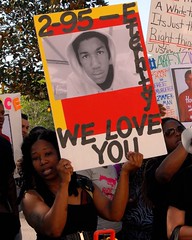
Trayvon Martin Protest - Sanford
Trayvon Martin Protest - Sanford (Photo credit: werthmedia)

I keep thinking that there is one point the Sanford, Florida police department apparently has not fully considered: that if George Zimmerman had not followed Trayvon Martin, and had not exited his vehicle to approach the young man, Trayvon would be alive today.

It still feels like Trayvon was standing his ground. He was being followed by, and then approached by someone he did not know, who had a gun. It is reasonable to believe that the young man, frightened, defended himself against what he thought was a sure and present danger.

How come that possibility has seemingly not been advanced by the police department? In all the press conferences I have seen, not once have I seen the police say that they are considering that possibility as well.

What we have, why this case has brought out so much rage, is another example of what appears to be the willingness on the part of law enforcement to  devalue the life of a young African-American– again. Florida and indeed many states have a long history of injustice when it has come to incidents involving whites and blacks, with white people being given the benefit of the doubt and being let free. Black people have historically been discarded, devalued, as it were, and there is a sense of rage based on a history of injustice.

Isabel Wilkerson, author of the book The Warmth of Other Suns, wrote an excellent piece for CNN yesterday, describing the historical wrongs done as concerns whites and blacks as concerns crime committed and justice served or not served. That injustice, or the fear of injustice, prompted many African-Americans to  leave the South, to migrate to the North and to the Midwest, in search of  jobs, surely, but also in search for a place where they might get more justice.

That has not necessarily been the case, and everyone who is an African-American knows it. The fact that George Zimmerman has not been arrested, and the apparent fact that the possibility that Trayvon Martin could very well have been standing his ground, promotes anger that comes from an historical reality. It is not at all surprising that details about Trayvon’s apparent multiple suspensions from school, and about how traces of marijuana were found in his book bag. There has to be a reason for what Zimmerman did and how he did it; how better to do that than to create an image of a troubled, violence-prone teen?

But in spite of whatever details about Trayvon are released, it still doesn’t assuage the anger of people who are wondering why – again – it feels like a white man will get away with killing an African-American. The details about Trayvon do not erase the apparent fact that the young man was apparently approached by Zimmerman, in spite of the fact that he had been told not to do that. The details do not justify Zimmerman getting out of his car and apparently approaching Trayvon.

Something is wrong here, and lots of people know it.

A candid observation…

U.S. Supreme Court Doesn’t Inspire Confidence

I find that I do not have much confidence at all in the justice system of this nation. I have little confidence in police and other law enforcement officers, and I don’t have much confidence in the courts, including the United States Supreme Court.

When I was little, my second grade class was visited by “Officer Friendly.” We were taught that the police were the “good guys,” and we never had to worry if we were in trouble. That gave me, a little kid, a lot of confidence and a sense of security.

But while there are good police officers, what I found over the years is that police officers were often not the friend of African-Americans, and I found that the courts were often not so interested in being fair to African-Americans. In spite of the American democratic and judicial ideal of one being “innocent until proven guilty,” what I found as I read and studied was that African-Americans were often considered guilty and not worthy of proving innocence.  All-white juries, I read, convicted black people on the smallest of crimes and also on major crimes for which there was little to no substantiating evidence.

This America upheld or at least ignored Jim Crow, was reluctant to intervene in cases involving race, and would not pass a law outlawing lynching.

My heart was seriously broken, though, when in a sermon Rev. Dr. Jeremiah Wright preached that in the Dred Scott case, Chief Justice Roger Taney ruled that “there were no rights of a black man that a white man is bound to respect.”

I felt tears coming down my cheeks in spite of myself.

In the Dred Scott case, the U.S. Supreme court also ruled that the Bill of Rights didn’t apply to African-Americans. “If it did,” the Court ruled, “African-Americans would be able, in full liberty of speech in public and in private to hold public meetings upon political affairs and to keep and carry arms wherever they went.”

That was in 1856. In 1883, in Pace v. Alabama, the nation’s high court upheld an Alabama law which forbade interracial marriage. Such a marriage could land the offenders from two to seven years in prison. This ruling was overturned in Loving v. Virginia in 1967.

We all know about Plessy v. Ferguson, which ruled that there was such a thing as “separate but equal” when considering public institutions, a ruling which was overturned by Brown v. Board of Education in 1954. In Cumming v. Richmond, in 1899, three black families in Richmond County, Virginia, went to the court for justice when the closing of the area’s only high school for black students were closed. They wanted their children to be able to finish their education at the white high school, but the Court snubbed them, and said that if there were no suitable black school in a given district, African-American students would have to go without an education.

The more I read, the more I am floored, and that child’s disappointment with the reality of American as opposed to the myth of America comes back. The Affordable Health Care Act is now before the Court, provisions of which will help many of this nation’s citizens, but I have no confidence that the Court is interested in upholding or even establishing justice or equity. This nation’s high court does not seem to be on the side of “the least of these.” In Lum v. Rice, in 1927, a nine-year old Chinese girl, Martha Lum, faced the coldness of the court as concerns race. Congress had passed the Oriental Exclusion Act in 1924 to control the number of immigrants from Asia, but Asians already living in America were American citizens.

The problem was that there were not enough Asians for them to have their own school; strict separation of races in public schools was the law of the land, and so Lum’s family  appealed to the Court to attend the nearby white school. The Court said no.

Well, I don’t see where the justices on the Court today are any more inclined to lean toward “justice for the masses” than they were in the 19th and 20th centuries. I don’t feel that the justices’ definition of justice intersects with the definition of justice of so many Americans. It feels like the Court is interested, as it has always been interested, only in protecting the power, position and privilege of the status quo. Equity among the people is not an American value. “All men are created equal” does not mean every man, and this is not a country that espouses and pushes “liberty and justice for all.”  To believe in equity and/or equality, liberty and justice for all, is to lean dangerously to the Left, I am learning, putting oneself in position to be labeled a Socialist, or worse.

I am holding my breath on this Court’s ruling on the Affordable Health Care Act, but I won’t hold it long, I am afraid.

This Court has done little, unfortunately, to make me trust it or its intentions.

A candid observation…

African-American Males not Safe in America

When my son was little, people would stop, white people, I mean, and would say how cute he was.

He was cute. He still is…well, handsome, now, but when they would stop and proclaim how cute he was, I found myself thinking “yeah, as long as he’s little, he’s cute, but when he grows up, he’ll be just another black male.”  I resented what I knew to be true, but I would smile at the well-meaning people, and say “thank you.”

After all, he was cute.

When he went to a private school, he was one of two or three African-American boys in his third grade class. He had ADHD, and was frequently “in trouble” for being fidgety or disruptive. His third grade teacher seemed really not to like him, but I shrugged it off, thinking I was being overly sensitive.

But then one day, I ventured into his room. The students had behavior logs on their desks, and most had stars or stickers on their logs, but not my son. On his son, the teacher had drawn great big black “X’s, with the comment, “You are bad.” I was furious. I complained to the school administrators, who apologized profusely and said they were sure the teacher meant no harm.

Meant no harm? I talked with the mothers of the other two African-American boys and found out that this teacher had said to the three boys that they were a “gang.”  I remembered back when my son had asked what a gang was and I’d told him. He’d asked, “Is a gang bad?” And I said “yes,” never knowing that I was feeding into the message that his third grade teacher had given him, that he and his two African-American classmates were a “gang” and therefore, “bad.”

Then, there was the moment when I decided to put him on Ritalin. I fought it, but I was fighting a battle with school teachers who continually put him down, had low expectations, and labeled him as a behavior problem. I choked back tears when he got into my car after having taken the Ritalin for two days and said, “Mommy, for two years, I was bad. Now I’m good.”

It is important to say that I struggled to make sure I protected his spirit, strong-willed as he is. He is a brilliant young man, as he was a brilliant child. His spirit was his gift from God, and so I fought to protect it from those who sought to snuff it out. I shared with him how incredibly powerful his spirit was, and that he was to always remember that.

He was and is independent; he speaks his mind. I didn’t want him to lose those qualities, but I had to give him “the talk,” telling him how to act and react if he were ever stopped by police officers, telling him how he had to look out and be extra careful when he was out because he would always be more closely scrutinized. I told him not to hang out with kids who got into trouble, because if he was with a kid who got into trouble, he’d be picked up, too. I was working, even as he was a little boy, to save his life from the likes of people, who, when he was little, called him “cute.”

He graduated from high school with honors. He is a brilliant young man, and a talented writer and musician. He is still strong-willed and independent. He lives in New York and is doing “his thing.” And he is still alive and not in jail, thank God.

I thought about him, and have been thinking about him, as I have struggled with my feelings about what happened to Trayvon Martin. It is only by the grace of God that my son is alive and Trayvon is dead. I am getting angrier and angrier at America’s penchant for wielding injustice toward people of color, especially African-American males. I actually scoffed this morning when I heard a man on CNN say to the public to let justice run its course.

I don’t believe in American justice as pertains to African-Americans in general, and for African-American males in particular.

I wrote yesterday that racism is as American as is apple pie. It is especially noticeable when it comes to matters of justice. Our American history is peppered with tales of injustice in the lives of African-Americans, from the reality to slavery to the serious breaches of morality and ethical actions toward African-Americans once slavery no longer existed.

America has been the teacher to the world on how black people should be treated, so much so that not only in America, but everywhere, one would rather be anything but dark-skinned.

Walking hand-in-hand with racism has been white America’s arrogance, which has given a sense of entitlement and justification to treat African-Americans as sub-human and second-class citizens.

I am praying that George Zimmerman is arrested.  A young man is dead for doing nothing, and for being guilty of nothing other than being an African-American wearing a hoodie and therefore looking “suspicious.”  African-Americans, especially males, are not safe in America. Something is very, very wrong.

The Emancipation Proclamation was issued in the 19th century, but isn’t it unfortunate that in the 21st century, African-Americans are still held captive by racism and a justice system which has been anything but just for us? In fact, that justice system has been little more than a tool to put more and more African-Americans in new plantations called prisons …or in their graves.

It’s nice that white people thought my son was cute when he was little; I’ll bet they said the same thing about Trayvon when he was little, too. But cute little black boys are not safe in America, not once they grow up.

A candid observation…