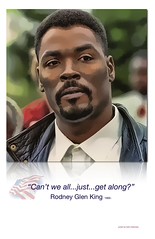
Rodney King: American Legend?

Rodney King poster
Rodney King poster (Photo credit: MarkGregory007)

An American legend has died.

Some may disagree with me, but how can Rodney King be called anything less than a legend?

When King’s horrific beating by police officers was caught on tape and publicized, I remember feeling a glimmer of hope. All along there had been cries of police brutality in the African-American community, but nobody would listen. The prevailing thought seemed to be that black people were just …bad people…and the good officers were only doing their jobs with  a people who had to be tamed.

No matter how loud the groundswell was from any particular community about what police were doing, nobody would listen. There seemed to be a “gentleman’s agreement” that what police did in black communities would remain in black communities, cries of injustice and excessive violence notwithstanding.

It made the black community feel invisible.

But with the video of King’s beating …I, and, I am sure, many others, felt like a just society would see. A justice system interested in justice would see; police departments all over the country would see; American citizens who were all too eager to write the black community off as troublemakers would see.

That belief spawned hope. Now it wouldn’t be “our” word against “theirs.” In a land where it was promised that there would be “liberty and justice for all,” justice would now come to the white officers who were caught on tape.

That was wishful thinking, however, and it really should be no surprise that after the officers were acquitted that there was a backlash. If it was that not even a video which showed what African-Americans had talked about for so long that would shake the foundations of excessive force so often used by police on African-Americans, then what would work?

King’s beating represented a raisin in the sun, a raisin of hope which exploded in a thousand fragments as that hope was dashed.

King didn’t set out to become a legend, but what happened to him thrust the issue of police violence, police brutality, into the spotlight. He became a legend by default. What happened to him, and how the justice system really ignored what was on that tape, became fodder for those whose social justice focus is police brutality. I am not quite sure how much progress has been made, but for certain, the awareness of what happens on the streets with too many citizens and police officers was heightened by King’s unfortunate experience.

Lots has been said about King’s demons. He never did really get his life under control if media accounts are to be believed. Drugs and alcohol were constant companions, and he was able to squander millions of dollars awarded to him after his beating. Everyone knows about that.

But what we may not know, or may not want to admit, is that King is a part of the American fabric, a thread in the cloth that nobody wanted in the cloth, most especially powers that be that have a vested interest in protecting the status quo.

King’s beating, and the subsequent acquittal of those officers, made a dent in a long-sanctioned system of police brutality, and that really does make him a legend.

A candid observation …


When Humiliation Explodes

http://www.af.mil/shared/media/photodb/photos/...
http://www.af.mil/shared/media/photodb/photos/020903-o-9999b-098.jpg filedesc Tuskegee Airmen – Circa May 1942 to Aug 1943 Location unknown, likely Southern Italy or North Africa (Photo credit: Wikipedia)

Oppression, under any name, is humiliating.

I recently watched the HBO version of the story of the Tuskegee Airmen, a work which was much better, actually, than the film Red Tails. There were a lot of “ouch” moments in the film for me, but one particularly painful moment for me came in a scene where a white commanding officer told a black recruit that he was “nothing,” and after he was finished, the recruit was forced to salute.

It made my stomach turn.

Oppression comes in many forms: it may be racial or sexual; it may occur between a parent and child or a husband and wife or between partners. In all cases, oppression appears to be a form of sophisticated and sanctioned bullying, designed to keep the oppressed “in his or her place.”  And in assuring that “place,” someone is inevitably humiliated.

A woman, Marissa Alexander, was recently sentenced in Florida  to 20 years in prison for firing a warning shot into the air as her husband threatened her with violence. Domestic violence is a form of oppression, and it is humiliating.  As is the case with so many cases of oppression, the oppressor in the case of Alexander escaped charges in the incident; he is free while this mother is in jail for trying to protect herself and maintain a sense of dignity.

Oppressors have power because their oppression is supported by society; their society-sanctioned bullying is carried out so that they can maintain power, and that power is used not to uplift society but to belittle other individuals, but what people do not seem to understand that individuals can only take so much humiliation before they explode. People have a need, a desire, to be honored and to be treated with dignity, and when that doesn’t happen, after a while, something inside one’s spirit gives out.

In the HBO movie, the recruit who was early on humiliated was punished later for being a show-boat; he was a licensed pilot when he entered the Tuskegee program but was never honored as such. He was treated as a nothing, and so when he had an opportunity to “show his stuff” in a plane, he did so, and was punished by being put out of the program.  It was too much. He begged for mercy, to be allowed to stay in the program. He said he’d do anything…but his begging was for naught. In despair, he snapped; he ran impulsively to a plane, got in, and took off on a suicide flight. If he was going to be out of the program, he would be “out” on his own terms. He would NOT go home humiliated, not again.

That humiliation builds and then explodes is no surprise. What is troubling, however, is that oppression continues as a force in life, causing far too much despair, far too much humiliation.

Rev. Jesse Jackson said that people only revolt when they are humiliated. Race riots, women finally fighting back against abusive spouses, children exploding because of overbearing parents …all seem to bear out Jackson’s statement. After a while, those who are oppressed say “enough,” and violence ensues.

That’s not a comforting thought…but what it is is a troubling reality.

A candid observation …


Mashed Potato Bulletin's avatarMashed Potato Bulletin

This story about Romney’s accomplishments and problems as governor of Massachusetts illustrates the Romney many of us foresee entering the White House should he prevail against Obama. It’s a Romney who is unable to break away from the CEO mentality of “What I say goes”. One who can’t truly grasp what it means to work with other elected officials nor fully comprehend that members of state legislatures, or Congress for that matter, are not his employees who will obediently follow lockstep with every decision he makes. Given his past as governor, one would think Romney would comprehend better than most the frustrations Obama has faced in his attempts to move his policy forward amidst an ideologically driven opposition.  

View original post 423 more words

When Silence is Evil

The entire country has been in an uproar –  rightfully so – about the killing of Trayvon Martin.  The rush to apply Florida’sstand your groundlaw by Florida authorities to explain and justify the actions of accused shooter George Zimmerman has enraged this nation, most especially the parents of young Martin, who want justice in the killing of their son. We are all watching to see how this case pans out.

But there was another case of an individual using the “stand your ground” law, this one a young African-American woman, who did not kill but fired a warning shot to get her physically abusive husband away from her. In this case, unlike the Martin case, it was fairly clear that the woman, Marissa Alexander, was truly defending herself against her husband, but in spite of that, she was accused and convicted of attempted murder. Circuit Court Judge James Daniel sentenced her to 20 years in prison.

Seriously?

Alexander had never been in any trouble; she had never been in jail…and she believed in the justice system. She reportedly did not take a plea bargain that would have had her spend just three years in prison because she said, “I didn’t believe I had done anything wrong.”

Not only did Alexander not actually shoot her husband, but she had filed charges of domestic abuse against him before. In other words, there was a record of his abuse toward her. Her life had been in danger before …and yet, her action of self-defense was ignored. Twenty years in prison, despite a law that is supposed to let people “stand their ground.”

Something is wrong here…including our silence about this case.

I know, from reading books like The New Jim Crow and False Justice that once the justice system makes a ruling, it is extremely difficult to get that decision reversed. But just because such action is difficult does not mean we who see injustice should be silent.

Is it just me, or does this case reek not only of racism but sexism as well? Why is it NOT okay for women who are in abusive relationships to defend themselves? I remember visiting a women’s prison and being amazed at how many women were in jail because they had finally had enough of their husbands beating them to a pulp. Why is it NOT okay for women to defend themselves against abusive husbands, but it is somehow all right for a white man to “defend” himself against even the suggestion of bodily harm by an African-American or Latino man?  In spite of the reports we have had that George Zimmerman was advised by police officers to leave Trayvon Martin alone, he ignored that order and a young, unarmed African-American youth is dead…and the “stand your ground” law is being touted as the law that probably “saved” Zimmerman’s life.

Seriously?

There is no justifiable reason for Marissa Alexander to be in jail for firing a warning shot against her abusive husband. If that is not self-defense, then I am at a loss as to define what self-defense is.  Marissa has an 11-year-old daughter who not only had to witness violence between her parents, but who now has to live her young life without her mother. She also has to grapple with trying to understand why “the law” did not find a way to give justice to her mother.

Marissa has recently been denied a new trial. So, she sits in prison for trying to protect herself.

Something is wrong here…not least of which is our silence about his unfair and unjust case. Our silence is as evil as is the law that put her in jail, and the laws which do little to protect women in cases of domestic abuse.

A candid observation …

A Broader Understanding of “Pro-Life”

I have often found myself cringing as “pro-life” advocates have stood outside abortion clinics, pleading for the rights of an unborn fetus, not because I like it that there are so many abortions, but because those who are “pro-life” seem, for the most part, to have such a narrow understanding of  what life is.

In fact, although pro-life advocates have put billboards up in urban neighborhoods, urging people in those neighborhoods to refrain from having abortions, it seems that these same advocates, once the babies in these neighborhoods are born into poverty and despair, pretty much ignore them.

Children who live in poverty, who are born in poverty, depend on the government for basic services, like food and health care. Children born into poverty have a higher chance of ending up in prison, because the schools in their neighborhoods are so bad and they end up giving up and dropping out of school.

According to the Children’s Defense Fund, a “cradle to prison” pipeline exists because children born into poverty – yet very much alive – suffer from abject poverty, inadequate health care, gaps in childhood development, disparate educational opportunities, “intolerable abuse and neglect,”  “unmet mental and emotional problems, rampant substance abuse,” and involvement in an overburdened , ineffective juvenile justice system, a system which looks at these children as a drain on society.

These children, very much alive, are despised once they come out of the womb. As a fetus, a poor child is cherished; the heartbeat of the fetus is used in commercial and religious attempts to get people to oppose abortion. Yet, there is no such drumbeat for these children, and for the things they need once they are born in order to have valuable and viable lives, once they are born.

There is something very wrong with this reality.

Martin Buber, a Jewish theologian and Zionist, wrote a powerful book, I and Thou, where he described how we as human beings objectify other human beings, presumably to protect ourselves, our thoughts, and our beliefs.

He believed that part of the problem in Israel was the inability and unwillingness of Jewish people to treat Arabs as fellow human beings, “it” as opposed to “thou.” An “it” has no feelings; it is an object, devoid of even the need for another human being to invest caring and compassion into. A “thou,” on the other hand, is a “fellow human being,” one with which one can develop an empathic relationship, based on the understanding that this “thou” has needs and feelings equal to that of the person doing the evaluating.

“I-it” relationships have made it possible for sexism, racism, homophobia, discrimination against the aged …to flourish. When we as humans do not see another human as human, we feel nothing about what we may or may not do to affirm that person’s worth and need to meet their needs.

That’s the feeling I get that the pro-life proponents carry with them. The poor are precious so long as they are in the womb. Once out, they are a bane to society, unworthy of anyone’s time or concern.

If the pro-life people would advocate as hard for quality education for poor children as they do for more affluent children, or push for legislation or some other source to provide for quality health care for these children, I wouldn’t care about their concern and love for the unborn fetus. Poor children do not ask to be born, and they are not responsible for their conditions. It is so hypocritical and sad for a civilized society to have such a narrow definition and appreciation for life.

A candid observation …