Mass Murders and White Men


Seal of the City of Aurora, Colorado
Seal of the City of Aurora, Colorado (Photo credit: Wikipedia)


In the aftermath of the horrible shooting in Aurora, Colorado, I find myself asking what it is that compels people to want to commit mass murder.


And…I wonder why so many of these mass murders are done by white men.


I know people don’t like to talk about race, and I know it’s easier to talk about black on black crime.  While black on black crime raises hardly more than a whimper or cause for concern, when a black kills someone white, there is a fair amount of outrage.


But this mass murder thing: why is it that white men seem to be the primary perpetrators in crimes like these? Why is there still a sense of shock when it happens? How come there aren’t some studies being done to find out why this happens? Black on black crime has been said by some to be caused by the deep levels of self-hatred African-Americans have. Black on white crime is said to be caused by long-held anger on the part of blacks. White on black crime is credited to racism in many cases…but mass murder, perpetrated by white men on crowds of people, most of the time predominantly white, has no reason given, or at least I haven’t heard the reason. Have I missed something?


The latest alleged murderer, James Holmes, has murdered at least 12 people as of this writing, including a three-month old baby. He came into a crowded theater, released tear gas, and then opened fire. He apparently carried an arsenal of weapons, and he told police he had wired his apartment to explode. He came dressed all in black, and he apparently shot with abandon, aiming at nobody, yet aiming at everyone. This young man, 24, is, or was, a PhD candidate. I would assume he came from a fairly nice family, as “nice” is defined. So, what happened?


I think about the young me, Klebold, who shot and killed and wounded students at Columbine High School; the young men, Timothy McVeigh and Terry Nichols, who blew up the Murrah State Office building in Oklahoma City, the young man, , T.J. Lane,  who is accused of shooting students at Chardon High School in Ohio earlier this year; and of course, there was the horrific shooting in Colorado where Jared Loughner shot Representative Gabby Giffords and 18 other people in 2011…all white men, and I don’t get it. Why does this keep happening, again and again?


Could it be that white men harbor some degree of self-hatred too? Or is it they carry a lot of anger about …well, about what?  If white men are angry, and especially so angry that they feel compelled to shoot whomever is in their way, why are they that angry?


Isn’t it a topic or subject or situation that somebody ought to at least look into?


My heart is so heavy for the people who were shot in Colorado. All they were doing was watching a movie, and now, some are dead, some are wounded, and all who survived or who will survive are forever changed. It seems like a fair amount of Americans are suffering from post-traumatic stress syndrome, all due to domestic violence, and much of due to these mass killings.


It just seems that the tendency of white men to express their anger and rage through mass murder ought to be a subject for study. It’s proper to be horrified when these atrocities happen, but horror isn’t worth a dime if it cannot and does not lead to serious study so that the problem can be alleviated or reduced.


There are just way too many mass murders in America, too many white men who punish a slew of people for something they are upset about. It’s time for it to stop. Past time, actually.


A candid observation …


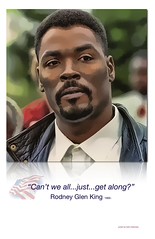
Rodney King: American Legend?

Rodney King poster
Rodney King poster (Photo credit: MarkGregory007)

An American legend has died.

Some may disagree with me, but how can Rodney King be called anything less than a legend?

When King’s horrific beating by police officers was caught on tape and publicized, I remember feeling a glimmer of hope. All along there had been cries of police brutality in the African-American community, but nobody would listen. The prevailing thought seemed to be that black people were just …bad people…and the good officers were only doing their jobs with  a people who had to be tamed.

No matter how loud the groundswell was from any particular community about what police were doing, nobody would listen. There seemed to be a “gentleman’s agreement” that what police did in black communities would remain in black communities, cries of injustice and excessive violence notwithstanding.

It made the black community feel invisible.

But with the video of King’s beating …I, and, I am sure, many others, felt like a just society would see. A justice system interested in justice would see; police departments all over the country would see; American citizens who were all too eager to write the black community off as troublemakers would see.

That belief spawned hope. Now it wouldn’t be “our” word against “theirs.” In a land where it was promised that there would be “liberty and justice for all,” justice would now come to the white officers who were caught on tape.

That was wishful thinking, however, and it really should be no surprise that after the officers were acquitted that there was a backlash. If it was that not even a video which showed what African-Americans had talked about for so long that would shake the foundations of excessive force so often used by police on African-Americans, then what would work?

King’s beating represented a raisin in the sun, a raisin of hope which exploded in a thousand fragments as that hope was dashed.

King didn’t set out to become a legend, but what happened to him thrust the issue of police violence, police brutality, into the spotlight. He became a legend by default. What happened to him, and how the justice system really ignored what was on that tape, became fodder for those whose social justice focus is police brutality. I am not quite sure how much progress has been made, but for certain, the awareness of what happens on the streets with too many citizens and police officers was heightened by King’s unfortunate experience.

Lots has been said about King’s demons. He never did really get his life under control if media accounts are to be believed. Drugs and alcohol were constant companions, and he was able to squander millions of dollars awarded to him after his beating. Everyone knows about that.

But what we may not know, or may not want to admit, is that King is a part of the American fabric, a thread in the cloth that nobody wanted in the cloth, most especially powers that be that have a vested interest in protecting the status quo.

King’s beating, and the subsequent acquittal of those officers, made a dent in a long-sanctioned system of police brutality, and that really does make him a legend.

A candid observation …


The Problem With America and Race

America, “methinks thou dost protest too loudly.”

The quote, from Shakespeare’s “Hamlet,” has been resonating with me all week.

As the Trayvon Martin case continues to be covered, with an emphasis on the possibility of his death being a hate crime, many people have protested – loudly and vehemently – that it is nothing of the sort.

Trayvon’s shooting may or may not have been racially motivated, but as I have thought about race in America this week, the thought has recurred to me that America doesn’t understand why race IS always an issue for us.

It is because, in the most simple terms, an issue of trust. Black people, African-Americans, do not trust white America. African-Americans do not trust the actions of white America or the intentions of white America. The relationship between the two races is one of suspicion based on evidence-based actions of white America which have worked to the detriment of African-Americans.

If we take it out of racial terms for a minute, and just look at the two races as two entities in relationship, we can see that the relationship has been “broken” from the beginning, in spite of absolutely glorious documents establishing America as a democracy. From the beginning, white America made it clear – and exercised its power to enforce its clarity – that they believed African-Americans were  inferior and unworthy of receiving rights guaranteed to all Americans by this country’s Constitution.

America’s blacks and whites are like a married couple in trouble, where one has continually abused the trust of the other and the other has developed coping behaviors to deal with the constant disrespect shown. In spite of efforts, some honest and some paltry, to fix the relationship, the dishonesty in behavior and intentions on the part of the “cheating spouse” has continued, and so the relationship between the two parties has continued to disintegrate.

As in many relationships where one has been unfaithful (in this case, white America being unfaithful to the ideals of liberty and equality espoused by the Constitution), the one who has done the cheating has the burden of doing whatever he or she can to regain the trust of the partner who has been cheated on. Counselors will tell cheating partners that if he or she wants the relationship, he or she will have to be willing to do whatever is necessary to mend the bonds of broken trust.

Many partners cannot handle the process of building or rebuilding trust. The partner who has been cheated on is OK for time, but the slightest deviation in word or action on the part of the cheating partner will bring back painful memories, the process of rebuilding has to begin all over again.

Only those relationships where the cheating partner is willing to take the crying, the complaining, the fear, the anger, and the resentment at having been disrespected until  a healing takes place, survive.

When it comes to white and black America, the relationship has never healed, and in fact, white America has too often continued to abuse the relationship between the two races by practicing discrimination and enacting policies that continue to belie a sincere desire to heal the relationship.

Dr. Martin Luther King spoke of the “disillusionment of Negroes” in his book Why We Can’t Wait, written in the mid 1960s. African-Americans, he wrote, struggled and fought for desegregation of public schools, because the quality of education in white schools, as opposed to black schools, was so disparate. “Separate but equal” was an unreality, and all African-Americans wanted, he explained, was a level playing field in the area of education so that African-American children would have the same possibilities for latching onto the American dream as did white children.

Much of white America, however, resented the historic Brown vs. Education ruling by the United States Supreme Court, and at the time of the writing of Why We Can’t Wait, ten years after the decision, many schools had not been integrated because white educators and legislators were still finding loopholes in the laws requiring integration. Integration was supposed to happen “with all deliberate speed,” the High Court had ruled, but its words were ignored…and no court, no legislature, did anything about it.

King wrote that “the Supreme Court retreated from its own position by giving approval to the Pupil Placement Law…which permitted the states themselves to determine where school children might be placed by virtue of family background, special ability and other subjective criteria.” (italics mine)

Though there was verbal non-support of discrimination in housing and employment during the Kennedy administration, Dr. King wrote, the fact of the matter was that government, state and local, continued to allow discrimination under the mantra of “states’ rights.” King correctly observed that though the Emancipation Proclamation had been a signed at that time 100 years before the time in which he wrote, there had been little true freedom for African-Americans.

What is there to trust in this relationship between the American government and its African-American citizens?

The pattern of the government saying one thing, yet supporting and permitting just the opposite, then, eroded the capacity of African-Americans to trust this same government. Perhaps the heart of America and its general disdain toward African-Americans can be found in the fact that the federal government never passed an anti-lynching bill. In the area of justice shown toward African-Americans, the country’s record was dismal, and continues to be. Not only black, but brown and poor people have little chance of experiencing the full majesty of America’s justice system.

And yet, white America expects African-Americans to “be happy and content.” The breach of trust is never spoken of or acknowledged, and the patterns of discrimination continue, in spite of our Constitution.

Though people like GOP presidential hopeful Rick Santorum carry the belief that “black people are spending other people’s money,” the fact is that the majority of African-Americans have pushed through the system, the laws and the governments which have done all they can to keep them in  second-class citizen status. In spite of discrimination in hiring, housing, lending, education and justice, African-Americans have pushed through and made their own way in a country which has tried at every step to block that way.

But it is unfortunate, the relationship between blacks and whites. The trust is not there, and no attempt is being made to build or establish the trust. Those who have been “cheated on” in a relationship supposedly built on trust can recall, I am sure, their discomfort with their partner after “the breach.” The desire to continue on has been there, but has been made all the more difficult by this breach …and if the offending partner has not only not apologized but has continued to repeat the offending behavior, repair of that relationship is almost certainly not going to happen.

Perhaps if there were a national counseling initiative, a “truth and reconciliation” effort like that done in South Africa, the lack of trust might be addressed and workable solutions found…but as things stand, the relationship between blacks and whites is toxic and volatile. There is no way, as we have heard during the debacle called the Trayvon Martin case, that black people are going to “trust the system” and  be willing to “let the system work.”

Our experience has been that “the system” does not and has not intention of, working for us, not without behemoth effort and push back from a system that seems to be filled with people who resent African-Americans even being in this nation.  African-Americans have tasted the cup of injustice, over and over again, and its bitter taste remains in our spirits.

If there is no trust, there can be no relationship, not between two individuals, not between nations…and not between two races, these two races, called black and white.

A candid observation …

The Racial Double Standard of American Politics

Republican Presidential candidates at the Ames...
Image via Wikipedia

For the past few days, there has been much attention placed on comments made by Republican presidential hopefuls as concerns their thoughts and opinions about black people.

Needless to say, there has been little to nothing complimentary. New Gringrich says black kids have no work ethic; he thinks black kids ought to get part time jobs as janitors (and thereby push the union guys out who have a job to support their families). He most recently said that black people ought to demand paychecks, not food stamps.

Rick Santorum said that President Obama ought to oppose abortion because he’s black. More outrageous, he said, “I don’t want to make black people’s lives better by giving them somebody else’s money. I want to give them the opportunity to go out and earn the money and provide for themselves and their families.”

He has since said he didn’t say “black” people and that he stumbled on his words; he was “tongue-tied.”

Ron Paul has been linked to newsletters published under his name which have published ridiculously bigoted statements. A newsletter which referred to the 1992 riots in Los Angeles had Paul saying that “order was only restored when it was time for blacks to pick up their welfare checks.”

Never mind that these statements are inaccurate and feed into a mindset that black people are lazy, that they dominate the welfare rolls, and, by suggestion, that black people and their plight are largely responsible for the vast amount of entitlement spending.

What I have noticed is that these politicians often say things like this when they are in the midst of all-white, receptive audiences.  GOP presidential candidates have been famous for ignoring the conference of the NAACP, something which New Gingrich recently faulted them for and said he would go if he is invited.

But what hit me is that GOP candidates make no effort to talk to black and brown people, though they say they want more black and brown people to join their ranks. They unabashedly cater not only to white people, but to white people whose views align with theirs.

That is politically all right, and necessary, one guesses, but if a person is elected president of this nation, isn’t he or she supposed to represent, to know and understand, the needs of all of the people?

Had President Barack Obama only catered to black people, he would never have been elected, and he would have been labeled a racist. One of his weaknesses has been that he has tried hard not to be “too black,” too interested in the needs of black and brown people. He has really partnered with big business an awful lot; he has reached across the aisles and tried to practice bi-partisanship, but it hasn’t worked.

But that’s what a president is supposed to do, right?

The point is, that if a person wants to be president, he or she ought to “sit down” with some of everyone who is American: Jewish, Muslim, black, white, rich, poor, Appalachian…America is a diverse nation. White candidates ought not be allowed to get away with just catering to a sympathetic and supportive white base.

Rick Santorum felt perfectly at ease talking about how black people ought not be using other peoples’ money to his all white, Mid-West audience the other night. I doubt he would have been comfortable saying that had he been speaking to a mixed crowd in an urban environment.

It is an ideal, I know, but the president of this nation ought to be at least ostensibly trying to reach out to all of America’s people and groups. The role of president on one level is not unlike that of a pastor, who has to be connected to all of his or her congregants, no matter how different.

Too many GOP candidates don’t seem to understand this basic requirement.

A candid observation …

© 2012 Candid Observations