
Only when people think a problem is THEIR problem do they mobilize … and work.
Activist Chip Berlet said that people have to SEE trouble before they act on trouble. When people SAW, for example, women and children being attacked by police dogs and hosed down with fire hoses like they were pieces of burning wood, they acted – or reacted. From President Kennedy on down, people reacted. What they SAW horrified them.
When people SAW residents of New Orleans stranded on rooftops, standing in the heat on the Danzinger Bridge and outside of the Convention Center; when they SAW pictures of old people, sitting dead in wheelchairs after that horrific storm …they reacted.
We like to think that we are nice people; we like to think that we care about things. Thing is, our “niceness” usually needs a bump to get it activated and we usually care most when a situation touches and affects us directly.
Heroin addiction is on the rise; it apparently is no longer a “ghetto drug” but has made its way to people who are affluent. Now, THEIR children are overdosing; now THEIR families are being affected. Now they can SEE how devastating the drug is (and always has been) and because THEIR children and family members are falling because of it, they can also see that it’s not BAD people who become addicted.
Because THEIR children, THEIR family members, are not bad.
Right now, there is a pandemic of black and brown and poor people going to prison. Michelle Alexander, author of The New Jim Crow, has told the story well, and in such a way that nobody can escape its power. At an event at which she recently spoke, she said something profound; she said, “All of us are sinners, and all of us are criminals.”
When the Prison Industrial Complex begins to really affect children other than black, brown and poor children, that statement will have new buoyancy.
But right now, what’s far too isolated, far too removed from THEM …is this whole issue of extrajudicial murders. Black children, black men and young boys, are being murdered. Some of the murdered’s organs are being removed. It is not a small problem; it is large and it is growing. And yet, there is silence…
THEY are not connected; THEY have not seen the horror for themselves. Who is “THEY?” Anyone who needs to see a problem but who does nothing. “THEY” are white and black and brown. “THEY” like to keep their heads in the sand and pursue their own material success and THEY do it well …until THEY see what’s going on because it affects THEM.
These kids and young people being murdered is a problem, an American, not a black problem, and it is spreading like a thick, black ink across our nation, city by city. Mothers and fathers and relatives are wailing, unable to get justice for their slain loved ones, because it has not touched THEM.
But it will. Spreading ink doesn’t make choices on who it stains; it stains anyone in its way …and the truth of the matter is that all of us are in its way. Some of us are just closer.
Trust and believe, the ink moves toward us all. The slain children and young people …are calling out to us all to SEE what’s going on …before it touches US.
A candid observation …
Tag: Police brutality
Rodney King: American Legend?
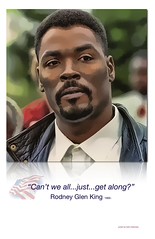
An American legend has died.
Some may disagree with me, but how can Rodney King be called anything less than a legend?
When King’s horrific beating by police officers was caught on tape and publicized, I remember feeling a glimmer of hope. All along there had been cries of police brutality in the African-American community, but nobody would listen. The prevailing thought seemed to be that black people were just …bad people…and the good officers were only doing their jobs with a people who had to be tamed.
No matter how loud the groundswell was from any particular community about what police were doing, nobody would listen. There seemed to be a “gentleman’s agreement” that what police did in black communities would remain in black communities, cries of injustice and excessive violence notwithstanding.
It made the black community feel invisible.
But with the video of King’s beating …I, and, I am sure, many others, felt like a just society would see. A justice system interested in justice would see; police departments all over the country would see; American citizens who were all too eager to write the black community off as troublemakers would see.
That belief spawned hope. Now it wouldn’t be “our” word against “theirs.” In a land where it was promised that there would be “liberty and justice for all,” justice would now come to the white officers who were caught on tape.
That was wishful thinking, however, and it really should be no surprise that after the officers were acquitted that there was a backlash. If it was that not even a video which showed what African-Americans had talked about for so long that would shake the foundations of excessive force so often used by police on African-Americans, then what would work?
King’s beating represented a raisin in the sun, a raisin of hope which exploded in a thousand fragments as that hope was dashed.
King didn’t set out to become a legend, but what happened to him thrust the issue of police violence, police brutality, into the spotlight. He became a legend by default. What happened to him, and how the justice system really ignored what was on that tape, became fodder for those whose social justice focus is police brutality. I am not quite sure how much progress has been made, but for certain, the awareness of what happens on the streets with too many citizens and police officers was heightened by King’s unfortunate experience.
Lots has been said about King’s demons. He never did really get his life under control if media accounts are to be believed. Drugs and alcohol were constant companions, and he was able to squander millions of dollars awarded to him after his beating. Everyone knows about that.
But what we may not know, or may not want to admit, is that King is a part of the American fabric, a thread in the cloth that nobody wanted in the cloth, most especially powers that be that have a vested interest in protecting the status quo.
King’s beating, and the subsequent acquittal of those officers, made a dent in a long-sanctioned system of police brutality, and that really does make him a legend.
A candid observation …
 Candid Observations