No Justice for Black Men

It is beyond the pale of understanding, what happens sometimes in the name of justice.

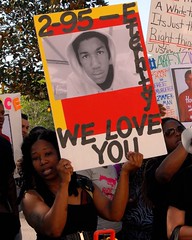
We are all still reeling from the Trayvon Martin case. Had it not been for the pushing of Sybrina Fulton that her son’s death be investigated and that there be a trial, young Martin would have just been another black kid who bit the dust, who had been shot by a vigilante, for sure, but who had probably deserved his own death. If I am not mistaken, I think something to that effect was suggested in the trial of George Zimmerman by Zimmerman’s defense team – that Martin was responsible for his own death.

Martin’s death and the subsequent trial, with the nearly all-white jury acquitting Zimmerman, was hard to swallow.  It was another instance of justice denied…but Martin’s situation was in no way an isolated event.

Most recently, there was a 43-year-old black man, Jack Lamar Roberson, who was shot and killed in his home in Waycross, Georgia, as he walked out of his kitchen with, apparently, two butter knives. An emergency squad was called by Roberson’s fiancée after Roberson took too much of his medication for his diabetes and was acting strange.  The news report said, however, that police responded to her call. When they came into the Roberson home, they saw him coming out of the kitchen “with weapons in his hands.” Police said he “raised his hand in a threatening manner,” (another report said he lunged at them) and they shot and killed him.

Diane Roberson, Roberson’s mother, said the police are lying, a charge that is not hard to believe. Police have far too often shot and either wounded or killed black men and have gotten off with the story that they felt threatened. America accepts their explanations far too often, and the cost, of course, is black lives snuffed out with hardly a word about it.

Black people have been criminalized, there is no doubt. It is a process that began after Reconstruction, when white people in the South, angry that they had lost good and free labor when slavery was abolished, came up with a system of enslaving blacks in another way. The Convict Lease system was carefully built and supported by charging black men for minor offenses and jailing them when they could not pay fees (which were purposely set too high for them to afford). They were leased out to farmers and businesses, where they worked for little to nothing, and could be re-sentenced if, at the end of one sentence, they couldn’t pay the fees to become totally free. Little by little, white America began to see that black people were always in jail, with the claim that black people were not suited to be free. The image and the message circulated was that black people were bad, were criminals …and that began to breed a fear of black people that has only grown.

The fact that Mark O’Mara, George Zimmerman’s attorney, could and would suggest that Trayvon Martin caused his own death still infuriates me. The fact that law enforcement was not going to investigate Martin’s death but was going to just take Zimmerman’s word, is infuriating.  In Waycross, Georgia, there is the case of young Kendrick Johnson, whose death law enforcement ruled an “accident.” He was found in a wrestling mat, and the story was that he died reaching for a shoe. Justice? Really? His parents said the story reeked and asked for his body to be exhumed and a second autopsy be done, and that autopsy revealed that Johnson died of blunt force trauma to the neck.

There are so many cases of black men being killed by law enforcement or by vigilantes and nobody says anything …or, if they do, their voices are snuffed out. Black mothers, if they are smart, are still telling their sons to be careful, and are still telling them how to engage with police officers.  Police officers are supposed to be the protectors of the innocent, but in the case of black men, they are very often the aggressors whose actions are accepted and sanctioned.

Ruby Sales, a veteran civil rights worker and the founder and co-director of the Spirit House Project, has begun in earnest to look into these murders. Michelle Alexander, the author of The New Jim Crow, has broken open the disparities inherent in the incarceration of black people in this nation. Iva Carruthers, general secretary of the Samuel Dewitt Conference, Inc., has held hearings all over the country, getting testimony from people from whom justice has been withheld.

Slowly, but surely, these cases are coming to light. There is no need in saying that America is a democracy when in fact the justice system is not interested in “liberty and justice for all.” Too many black men are dying under suspicious circumstances …and “we the people” need to know it and work to end it.

A candid observation …
 

Dorner Must Not Have Known

Chris Dorner, the ex-Los Angeles police officer, must not have known that injustice…is real.

The story about  Dorner,  who has gone on a shooting rampage targeting other police officers, is intriguing and troubling, yet it speaks to some truths that we all live with.

Dorner has apparently snapped because of a grudge he has been holding for a number of years. According to news reports, he feels that he was unjustly fired from the Los Angeles Police Department. He is angry, according to reports, that “his truth” was not accepted and despite his best efforts to seek justice for himself, he failed.

A court upheld the action taken by the police department. The court hearing his case was apparently his hope, but his last hope, and when the court supported the police department, it was too much for Dorner.

In 2007, Dorner was a probationary police officer involved in the arrest of a man in San Pedro. He, along with his training officer, Teresa Evans, responded to a complaint of a man causing a disturbance in a hotel lobby. According to news reports, they found the man sitting outside the hotel when they arrived. They tried to take him into custody but he arrested. Dorner apparently wrestled him to the ground and Evans allegedly tasered him, after which the suspect surrendered to police.

A couple of weeks later, however, Dorner went to a sergeant and said that Evans, his partner and training officer, had kicked the suspect after he was down, after he had surrendered. The complaint was investigated by the police and was found to be unwarranted. Apparently Dorner had waited too long to report the apparent and alleged misconduct of Evans…That fact, coupled with the fact that hotel employees questioned would not corroborate Dorner’s claim, resulted in the investigation being ruled in Evans’ favor and Dorner being fired from the police force. Dorner was found guilty of having made untrue statements against a superior officer.

Dorner rose up in protest, taking his case to court. But the court, the center of the justice system, was not doling out the justice that Dorner sought, either.It seemed that nobody would listen to him and his rage grew deeper and deeper.

Injustice really does exist.

Dorner, who had also served in the military, learned this sad fact. He dared report his training officer, waiting two weeks to do so …and it backfired on him. What would have happened had he reported the alleged kicking of the suspect immediately? We do not know, but it is safe to assume that he was probably afraid to do so. It is safe to assume that what he saw bothered him so much, though, that he decided to take the risk and report one of his own. It didn’t work. At the end of the day, he was odd man out.

Dorner, one guesses, believed in justice and in the power of truth. He forgot, however, that police have been known to protect each other from the most heinous wrongs and accusations. He was not “in” the department yet; he was in training. He apparently did not understand that police officers, from what we read, protect their own, no matter what. If he was going to go against “his own” while he was in training, if he was that brash and arrogant, he was too big a risk to let “into” the ranks completely. He had to go.

The witnesses at the hotel who would not support Dorner’s version of what happened might very well have been visited by police and encouraged to support the official police version of what happened. It has been done before. Police know how to protect each other.

A report issued after Dorner’s claims were investigated by police said, “”The delay in reporting the alleged misconduct coupled with the witness’ statements irreparably destroy Dorner’s credibility, and bring into question his suitability for continued employment as a police officer.”  A story on CNN.com said, “The report found Dorner had made false statements to a superior while reporting the allegation that Evans had kicked the suspect and to internal affairs investigators looking into the claim.” (see http://www.cnn.com/2013/02/07/us/lapd-attacks-dorner/index.html?hpt=hp_t1)

Dorner couldn’t take it. He expected that someone would listen and support him, but it didn’t happen. People have a tendency that truth will always trump a lie or a series of lies, but that is not the case, not in life. Too often, lies trump and truth has to fight hard in order to bring the lies and liars down. In that process, many turn angry and bitter and disillusioned, which apparently is where Dorner found himself.

He had to live with the reality that injustice exists.

Unfortunately Dorner expected the justice system to hear him, hear his truth, and rule in his favor, but it didn’t happen. Equally unfortunate is the fact that the justice system has too often been guilty of not rendering justice, putting far too many people in prison for crimes they did not commit. According to a book written by Jim and Nancy Petro, False Justice, it is also true that even when there is compelling evidence that a guilty verdict was incorrect, the justice system is slow to consider that evidence and in many cases, ignores it. Jim and Nancy are not bleeding heart Liberals; they are steadfast Republicans who have seen the ravages of injustice within the justice system and are speaking out about it.

The reality that justice is elusive and that life isn’t fair renders people who know they are innocent to a state of despair. From what has been printed about Dorner, it seems that he is in despair, feeling like there is nowhere to go and nobody who will listen to him.

What he is doing is not going to clear his name. He will go down in history as a villain because he killed fellow police officers. What is sad is that he is feeling that his fellow police officers were not there for him, and many officers who break the code of silence practiced by police know that very feeling.

The prayer is that Dorner stops killing people soon, that he is captured before he harms any more innocent people. But from a distance, it is easy to believe that what Dorner said he saw really happened. He naively thought that this world and our justice system, beginning with police, is about justice. He sounds like he was an idealist, believing that the police are “the good guys.” Sometimes they are. Many times, they are not, and they are expert at covering up their wrongs.

He didn’t know that, apparently. He didn’t know that injustice happens, perpetrated and  supported too many times by the ones in charge of protecting people.

A candid observation …


Rodney King: American Legend?

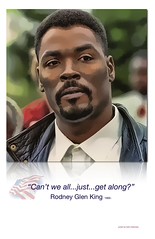
Rodney King poster
Rodney King poster (Photo credit: MarkGregory007)

An American legend has died.

Some may disagree with me, but how can Rodney King be called anything less than a legend?

When King’s horrific beating by police officers was caught on tape and publicized, I remember feeling a glimmer of hope. All along there had been cries of police brutality in the African-American community, but nobody would listen. The prevailing thought seemed to be that black people were just …bad people…and the good officers were only doing their jobs with  a people who had to be tamed.

No matter how loud the groundswell was from any particular community about what police were doing, nobody would listen. There seemed to be a “gentleman’s agreement” that what police did in black communities would remain in black communities, cries of injustice and excessive violence notwithstanding.

It made the black community feel invisible.

But with the video of King’s beating …I, and, I am sure, many others, felt like a just society would see. A justice system interested in justice would see; police departments all over the country would see; American citizens who were all too eager to write the black community off as troublemakers would see.

That belief spawned hope. Now it wouldn’t be “our” word against “theirs.” In a land where it was promised that there would be “liberty and justice for all,” justice would now come to the white officers who were caught on tape.

That was wishful thinking, however, and it really should be no surprise that after the officers were acquitted that there was a backlash. If it was that not even a video which showed what African-Americans had talked about for so long that would shake the foundations of excessive force so often used by police on African-Americans, then what would work?

King’s beating represented a raisin in the sun, a raisin of hope which exploded in a thousand fragments as that hope was dashed.

King didn’t set out to become a legend, but what happened to him thrust the issue of police violence, police brutality, into the spotlight. He became a legend by default. What happened to him, and how the justice system really ignored what was on that tape, became fodder for those whose social justice focus is police brutality. I am not quite sure how much progress has been made, but for certain, the awareness of what happens on the streets with too many citizens and police officers was heightened by King’s unfortunate experience.

Lots has been said about King’s demons. He never did really get his life under control if media accounts are to be believed. Drugs and alcohol were constant companions, and he was able to squander millions of dollars awarded to him after his beating. Everyone knows about that.

But what we may not know, or may not want to admit, is that King is a part of the American fabric, a thread in the cloth that nobody wanted in the cloth, most especially powers that be that have a vested interest in protecting the status quo.

King’s beating, and the subsequent acquittal of those officers, made a dent in a long-sanctioned system of police brutality, and that really does make him a legend.

A candid observation …


Trayvon Martin Case: Something is Very Wrong

Trayvon Martin Protest - Sanford
Trayvon Martin Protest - Sanford (Photo credit: werthmedia)

I keep thinking that there is one point the Sanford, Florida police department apparently has not fully considered: that if George Zimmerman had not followed Trayvon Martin, and had not exited his vehicle to approach the young man, Trayvon would be alive today.

It still feels like Trayvon was standing his ground. He was being followed by, and then approached by someone he did not know, who had a gun. It is reasonable to believe that the young man, frightened, defended himself against what he thought was a sure and present danger.

How come that possibility has seemingly not been advanced by the police department? In all the press conferences I have seen, not once have I seen the police say that they are considering that possibility as well.

What we have, why this case has brought out so much rage, is another example of what appears to be the willingness on the part of law enforcement to  devalue the life of a young African-American– again. Florida and indeed many states have a long history of injustice when it has come to incidents involving whites and blacks, with white people being given the benefit of the doubt and being let free. Black people have historically been discarded, devalued, as it were, and there is a sense of rage based on a history of injustice.

Isabel Wilkerson, author of the book The Warmth of Other Suns, wrote an excellent piece for CNN yesterday, describing the historical wrongs done as concerns whites and blacks as concerns crime committed and justice served or not served. That injustice, or the fear of injustice, prompted many African-Americans to  leave the South, to migrate to the North and to the Midwest, in search of  jobs, surely, but also in search for a place where they might get more justice.

That has not necessarily been the case, and everyone who is an African-American knows it. The fact that George Zimmerman has not been arrested, and the apparent fact that the possibility that Trayvon Martin could very well have been standing his ground, promotes anger that comes from an historical reality. It is not at all surprising that details about Trayvon’s apparent multiple suspensions from school, and about how traces of marijuana were found in his book bag. There has to be a reason for what Zimmerman did and how he did it; how better to do that than to create an image of a troubled, violence-prone teen?

But in spite of whatever details about Trayvon are released, it still doesn’t assuage the anger of people who are wondering why – again – it feels like a white man will get away with killing an African-American. The details about Trayvon do not erase the apparent fact that the young man was apparently approached by Zimmerman, in spite of the fact that he had been told not to do that. The details do not justify Zimmerman getting out of his car and apparently approaching Trayvon.

Something is wrong here, and lots of people know it.

A candid observation…

What If Trayvon Martin Was Standing HIS Ground?

The Sanford, Florida Police Department has said that it cannot arrest George Zimmerman for the fatal shooting of 17-year-old Trayvon Martin because they cannot find probable cause. Zimmerman has claimed self-defense, and because he had a cut on the back of his head and appeared to have been roughed up, they are claiming that self-defense cannot be ruled out.

But what if it was Trayvon Martin who was standing HIS ground?

Consider the circumstances, as described by news reports. The young Martin is walking home, hood on his head, minding his business. He is spotted by Zimmerman, who calls 911 and says Martin looks “suspicious.” He starts following Martin in his car, although police tell him he doesn’t need to do that. The 911 tapes reveal that Zimmerman agrees to meet police at the front gate.

But Zimmerman continues to follow young Trayvon. I am sure that the youth knew he was being followed and became nervous. Then, for some reason, Zimmerman gets out of his car. The news reports do not say that Trayvon’s body was found next to Zimmerman’s car, which would have shown that Trayvon approached Zimmerman. Rather, Trayvon’s body was found on the grass not far from his stepfather’s home in the gated community.

That says to me that Zimmerman got out of his car and approached Trayvon. Wouldn’t that mean that Trayvon felt threatened, and fought with Zimmerman, probably frightened as well as angry? Doesn’t the place where Trayvon’s body was found tell a story of his having been approached, suddenly, by this unknown man who had been following him in his car?

How come the Sanford police are not considering this scenario, which, the more I think about it, is much more likely what happened. Perhaps Trayvon yelled out to Zimmerman while he was in his car, asking him why he was following him…but the way the incident has been described still indicate that Trayvon was approached and assaulted by Zimmerman, not the other way around.

The chief of the Sanford Police Department is frustrated that this case is generating so much attention. I am not surprised; it would have been much easier to just let this case shake out the way Zimmerman has said, with another African-American young male the sacrificial lamb, “one more again.”

This is racism at its ugliest. It is the type of incident that shakes the very souls of African-Americans in this country, who have made strides not because of this country, but in spite of it.

It is a moral outrage, and an insult, and a slap in the face that Zimmerman has not been arrested, and that nobody is certain that he will be. Larger, this case speaks volumes for the raging infection called racism that is eating away at America’s very core.

A candid observation …