Affordable Care Act Overdue

HR3590-Patient-Protection-and-Affordable-Care-...
HR3590-Patient-Protection-and-Affordable-Care-Act_1 (Photo credit: Obama For America – California)

Sarah Palin is probably right: the passage of the Affordable Care Act by the United States Supreme Court will mobilize the Tea Party Conservatives, and probably others.

The presidential election will be fierce and fiery, more negative than it might have been had the High Court struck down the law, with cries of “socialism” leveled against President Obama.

But in the midst of the sound and the fury, poor people, unemployed people and underemployed people will have access to health care. And for that, I breathe a sigh of relief.

I am beginning to understand what I call the “politics of the fortunate,”  the “fortunate” being those lucky enough to have enough resources to live comfortably in this country. In many of their minds, entitlements, including Medicaid, welfare, and other large-scale programs funded by the government to aid the poor allow and encourage people to be lazy and content to allow others to pay for their needs.

What “the fortunate” don’t seem to understand is that while there are certainly people who take advantage of government programs, many people would rather die than take government assistance, yet would probably literally die were not government assistance available for them.

They don’t seem to understand that many of the unemployed are not working because they seriously cannot find a job; they don’t seem to understand that underemployment is as bad as is unemployment in many instances, not providing enough money for employees to adequately take care of themselves and their families.

What they don’t seem to understand is that just because a person is poor does not mean that that person does not deserve to be treated as a human being. People in the 21st century ought not be walking around with cancer that they cannot afford to get treated, or with abscessed teeth because they cannot afford to go to a dentist.

What they don’t seem to understand is that nobody wants to be poor. Nobody wants to struggle financially. And nobody wants to be penalized and be made to feel like they are not worthy of health care just because they are poor.

It feels strange to live in a country where many put more value on the proliferation of military might than on the protection and care-giving of its own citizens. It feels even stranger to be involved in wars that fight for democracy in other lands while democracy here is broken – because, surely, a country that does not take care of its poor is broken.

I have heard people today say that this health care bill converts America into a socialist country. I do not understand,  but I am sure it has something to do with the resentment that many have that the poor are being helped along by the government …and by their tax dollars.

If you never see the poor, look into their eyes, see how they live, see what they endure, then it’s easy to be dismissive and critical of their presence. If you have not been unemployed or underemployed, it is, again, easy to make judgments about people who are in those situations, and blame them for their situations.

Sarah Palin, like I said, is probably right. This action by the High Court is going to get the Tea Party boiling mad and energized in their fight against big government.

But as we have big government anyway, much of the recent “bigness” put in place by President Bush, causing us to go into serious debt, I rest a little easier knowing that some of my tax dollars are going to help those who absolutely cannot get out of their economic ruts. Like it or not, that is a reality in America. Perhaps one of the biggest differences  between the “haves” and the “have-nots”  is that those in the former group are more likely to have help to get out of their ruts, while the have-nots get more and more entrenched in theirs.

All people, wealthy or poor, deserve health care.  No human is so poor that he or she deserves to be treated like an object with no feelings and no needs.

A candid observation …

High Court a Political Machine?

English: West face of the United States Suprem...
English: West face of the United States Supreme Court building in Washington, D.C. Español: Edificio de la Corte Suprema de Estados Unidos en Washington, D.C. (Photo credit: Wikipedia)

If there is anything comforting about the impending decision on the constitutionality of the Affordable Care Act, is something that Charles Lane said in an article he wrote that appeared in The Washington Post:” …the United States periodically redefines the role of the federal government in society, in a process that is both political and legal — and, sometimes, more revolutionary than evolutionary. In that sense, we do have a “living Constitution.” (http://www.washingtonpost.com/opinions/charles-lane-redefining-american-government-through-obamacare/2012/06/25/gJQAdmIp2V_story.html).

What people want, or what we are taught to believe, that out of the three branches of the federal government, there is one branch, the judicial branch, that we can count on to interpret the law according to the Constitution, politics aside.

But that hasn’t been the case, and Lane quotes Akhil Amar, a professor of constitutional law at Yale University, who said that if the Court comes down against the Affordable Care Act by a margin of 5-4, it will show that it is not objective, but that it is bound by politics, party loyalty, money and party.

As a student of history, I have read of cases in which the High Court was not an agent for “the least of these;” I still shudder when I think of the wording Chief Justice Roger Taney used in the Dred Scott case. As part of the African-American community, I have yearned for a government that has been willing to live up to its ideals of being a government “of the people, by the people and for the people.”

What some Americans come to realize is that the government really advocates on behalf of “some” of the people, and some High Court decisions have validated that opinion.

Be that as it may, there is always a flicker of hope that in the end, no matter where else injustice may dwell, it will not be sanctioned by the United States Supreme Court. And so, when the Court shows its colors of party loyalty and politics, there is a collective sigh of dismay. If not even the highest court in this land sees “all of the people,” who will?

Perhaps my own state of mind is related to an erroneous way I have perceived America and the concept of democracy. I was taught – and I believed – that a democracy was different from other forms of government. I believed that that meant American democracy had a tradition of egalitarianism.  I believed that our democracy prided itself on “all” being equal.

That is not the case, however. All people in a democracy, more accurately a capitalistic democracy, are not supposed to be equal. Those who have get more and those who do not have…get less, and are chided for wanting what they see is possible.

At the end of the day, it seems that the United States Supreme Court justices are not people who believe in the make-believe of  “justice for all.” The laws of this nation were not set up to protect “all” people and I guess it is the work of the court to protect those laws, not “all” of the people.

So, I am bracing myself for the Court’s decision on health care. I am hoping that the gains made by the passage of the bill will not be lost; it is amazing that 46 million more people have health insurance because of this bill. It is inconceivable to me that a nation that is supposed to be so concerned with the treatment of people in other countries seems to be so callous when it comes to dealing with its own poor.

If I hadn’t had such good civics and social studies teachers, who taught me that America was probably the only country in the world that cared about the rights and care of everyone,  perhaps I wouldn’t have been so disappointed, time and again, when the High Court has not come off as the protector of America’s underclass, poor, and working poor.

Perhaps part of the issue, or my issue, with the Court is that it cannot let the Constitution breathe – it cannot allow that the Constitution is a live, living document, like Professor Akhil Amar said. Times change and so do the needs of the people and of the nation. Shouldn’t the law, even the Constitution, allow for that? Would the Founding Fathers have been pleased with a democracy where 46 million people didn’t have health care?

I’m blessed to have health care. I sure hope that by this time tomorrow, people who recently got access to health care after not having been able to afford it are not wringing their hands in despair, pushed yet again to the curb in the name of politics.

It would be the saddest thing ever…

A candid observation


America’s Moral Economy and the Issue of Health Care

I read a story in The New York Times (http://www.nytimes.com/2012/06/23/health/oregon-study-reveals-benefits-and-costs-of-insuring-the-uninsured.html?smid=fb-share) about a woman who “shattered” her ankle. Because she did not have health insurance, the emergency room put the ankle in an air cast, but doctors would not perform the surgery she needed. As a result, she “hobbled around in pain” for four years, causing her to gain weight, miss work and suffer other health challenges.

This woman did not live in a Third World country. She lives in the United States.

As the country awaits the United States Supreme Court‘s ruling on the constitutionality of the Affordable Care Act (aka “Obamacare), I find myself shuddering because I am worried that the Court will rule against the bill and if it does, so many people will again be out of luck.

The health care bill, though unpopular because opponents say it’s government-controlled, really does do some helpful things, like allow children with pre-existing conditions to get health care, children to stay on their parents’ plans until they reach age 26, and will eventually allow anyone with a pre-existing condition to get health care.

If the bill is shot down by the Court, however, all of those really positive gains will be lost.

What gets me is how this nation, which calls itself “the greatest nation in the world,” can live with itself when people like the woman mentioned at the beginning of this piece are walking around in pain in spite of our “greatest health-care-system-in-the-world” claim. How can any system be that great when the very people who need it most are shut out?

By now, people have heard of tragedies like children, primarily poor children, dying from such fixable ailments as an impacted tooth. Without health care, these children cannot afford the most basic of care, which also for them happens, many times, to be life-saving. Children and adults have been cut off from receiving necessary chemo-therapy or other treatments when Medicaid has refused to cover such treatment. Can this really be the reality of the so-called “greatest” nation?

Not having health insurance keeps some people from even seeking the care and treatment they need. In the same New York Times article, a woman, 24 years old, was said to be suffering from depression and C

English: President Barack Obama's signature on...
English: President Barack Obama’s signature on the health insurance reform bill at the White House, March 23, 2010. The President signed the bill with 22 different pens. (Photo credit: Wikipedia)

rohn’s disease, but also for stage 2 cervical cancer – for which she cannot afford treatment.

In Oregon, there has been created a lottery where people can “win” health care through the lottery system. Because of that, some people now have health care.  The article is lifting up alternatives to the present health care system, where so many people are left out and is also presenting the benefits and cost of insuring previously uninsured people. The lottery, by allowing people to “win” health care, is apparently a win-win situation for the state and for the “newly insured,” who are getting better care and are cutting health costs in other areas.

That some states are looking for alternatives to our present system is a comfort, but that the federal government is not so supportive of a health care system that takes care of more Americans is troubling. We as a nation seem to have little time or patience for those who are poor and who depend on the government for help. There is a moral economy here that is not working, but the federal government and too many state governments seem unable and unwilling to look at that issue.

In effect, not providing the poor, the unemployed and underemployed with viable health care seems to be immoral, in a country which touts itself as a moral leader in and of the world. I don’t think a nation can be “moral” and not only blame “the least of these” for their predicaments, but also ignore them as much as possible.

I would bet that the nation’s highest court would not agree with me, but we will see, sooner rather than later.

For the sake of people like the 24-year-old woman who is walking around without getting treatment for serious illnesses and diseases, I hope I am wrong.  No nation can afford to ignore its masses, our nation included.

A candid observation …

Rodney King: American Legend?

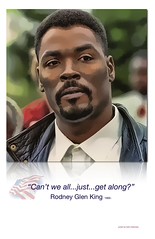
Rodney King poster
Rodney King poster (Photo credit: MarkGregory007)

An American legend has died.

Some may disagree with me, but how can Rodney King be called anything less than a legend?

When King’s horrific beating by police officers was caught on tape and publicized, I remember feeling a glimmer of hope. All along there had been cries of police brutality in the African-American community, but nobody would listen. The prevailing thought seemed to be that black people were just …bad people…and the good officers were only doing their jobs with  a people who had to be tamed.

No matter how loud the groundswell was from any particular community about what police were doing, nobody would listen. There seemed to be a “gentleman’s agreement” that what police did in black communities would remain in black communities, cries of injustice and excessive violence notwithstanding.

It made the black community feel invisible.

But with the video of King’s beating …I, and, I am sure, many others, felt like a just society would see. A justice system interested in justice would see; police departments all over the country would see; American citizens who were all too eager to write the black community off as troublemakers would see.

That belief spawned hope. Now it wouldn’t be “our” word against “theirs.” In a land where it was promised that there would be “liberty and justice for all,” justice would now come to the white officers who were caught on tape.

That was wishful thinking, however, and it really should be no surprise that after the officers were acquitted that there was a backlash. If it was that not even a video which showed what African-Americans had talked about for so long that would shake the foundations of excessive force so often used by police on African-Americans, then what would work?

King’s beating represented a raisin in the sun, a raisin of hope which exploded in a thousand fragments as that hope was dashed.

King didn’t set out to become a legend, but what happened to him thrust the issue of police violence, police brutality, into the spotlight. He became a legend by default. What happened to him, and how the justice system really ignored what was on that tape, became fodder for those whose social justice focus is police brutality. I am not quite sure how much progress has been made, but for certain, the awareness of what happens on the streets with too many citizens and police officers was heightened by King’s unfortunate experience.

Lots has been said about King’s demons. He never did really get his life under control if media accounts are to be believed. Drugs and alcohol were constant companions, and he was able to squander millions of dollars awarded to him after his beating. Everyone knows about that.

But what we may not know, or may not want to admit, is that King is a part of the American fabric, a thread in the cloth that nobody wanted in the cloth, most especially powers that be that have a vested interest in protecting the status quo.

King’s beating, and the subsequent acquittal of those officers, made a dent in a long-sanctioned system of police brutality, and that really does make him a legend.

A candid observation …


A Broader Understanding of “Pro-Life”

I have often found myself cringing as “pro-life” advocates have stood outside abortion clinics, pleading for the rights of an unborn fetus, not because I like it that there are so many abortions, but because those who are “pro-life” seem, for the most part, to have such a narrow understanding of  what life is.

In fact, although pro-life advocates have put billboards up in urban neighborhoods, urging people in those neighborhoods to refrain from having abortions, it seems that these same advocates, once the babies in these neighborhoods are born into poverty and despair, pretty much ignore them.

Children who live in poverty, who are born in poverty, depend on the government for basic services, like food and health care. Children born into poverty have a higher chance of ending up in prison, because the schools in their neighborhoods are so bad and they end up giving up and dropping out of school.

According to the Children’s Defense Fund, a “cradle to prison” pipeline exists because children born into poverty – yet very much alive – suffer from abject poverty, inadequate health care, gaps in childhood development, disparate educational opportunities, “intolerable abuse and neglect,”  “unmet mental and emotional problems, rampant substance abuse,” and involvement in an overburdened , ineffective juvenile justice system, a system which looks at these children as a drain on society.

These children, very much alive, are despised once they come out of the womb. As a fetus, a poor child is cherished; the heartbeat of the fetus is used in commercial and religious attempts to get people to oppose abortion. Yet, there is no such drumbeat for these children, and for the things they need once they are born in order to have valuable and viable lives, once they are born.

There is something very wrong with this reality.

Martin Buber, a Jewish theologian and Zionist, wrote a powerful book, I and Thou, where he described how we as human beings objectify other human beings, presumably to protect ourselves, our thoughts, and our beliefs.

He believed that part of the problem in Israel was the inability and unwillingness of Jewish people to treat Arabs as fellow human beings, “it” as opposed to “thou.” An “it” has no feelings; it is an object, devoid of even the need for another human being to invest caring and compassion into. A “thou,” on the other hand, is a “fellow human being,” one with which one can develop an empathic relationship, based on the understanding that this “thou” has needs and feelings equal to that of the person doing the evaluating.

“I-it” relationships have made it possible for sexism, racism, homophobia, discrimination against the aged …to flourish. When we as humans do not see another human as human, we feel nothing about what we may or may not do to affirm that person’s worth and need to meet their needs.

That’s the feeling I get that the pro-life proponents carry with them. The poor are precious so long as they are in the womb. Once out, they are a bane to society, unworthy of anyone’s time or concern.

If the pro-life people would advocate as hard for quality education for poor children as they do for more affluent children, or push for legislation or some other source to provide for quality health care for these children, I wouldn’t care about their concern and love for the unborn fetus. Poor children do not ask to be born, and they are not responsible for their conditions. It is so hypocritical and sad for a civilized society to have such a narrow definition and appreciation for life.

A candid observation …