Gun Control an Issue Only if You’re the Right Color?

Official Portrait of President Ronald Reagan.
Official Portrait of President Ronald Reagan. (Photo credit: Wikipedia)

I have been fascinated by the arguments and wrangling over gun control – specifically, not understanding why some think that banning assault weapons and magazines which have more than seven rounds of ammunition does NOT mean anyone is proposing that nobody own a gun.

But I am even more fascinated that the idol of modern-day Conservatives, Ronald Reagan, actually signed into a law a bill that repealed a law that had permitted citizens to carry loaded weapons in public places. The so-called Mulford Act was signed into law in 1967, when Reagan was governor of California. The measure was introduced by Dan Mulford, an East Bay legislator.

Apparently, some Americans were a bit nervous about the work of the Black Panthers, who back then, had formed “police patrols.” Members of these groups would listen on scanners for police calls and when something was happening in the black community, would rush to the scene, “law books in hand and inform the person being arrested of their  constitutional rights.” (http://www.pbs.org/hueypnewton/actions/action_capitolmarch.html) These individuals would also carry loaded weapons, which they apparently displayed….but “they were careful to stand no closer than ten feet from the arrest so as to not interfere with the arrest.”

When the Mulford Bill was passed, members of the Black Panther Party protested, and went to Sacramento, carrying their loaded weapons (including rifles and shotguns).

According to a piece that appeared on the site “Keep and Bear Arms” (http://keepandbeararms.com/newsarchives?XcNewsPlus.asp) Reagan “imposed gun control on America.”  According to the article, “Reagan declared his support for  a bill requiring a seven-day waiting period for handgun purchases.” The site confirms the fact that “Governor Ronald Reagan …signed the Mulford Act of 1967, “prohibiting the carrying of firearms on one’s person or in a vehicle, in any public place, or on any public street.”  The law, says the article, “was aimed at stopping Black Panthers, but affected all gun owners.”

The saddest thing about this entire gun control debate is that it really shows that the country really is not able or willing to deal with the proliferation of guns that exist in urban areas, where young men are shooting young men, most often poor and black. There are babies, black and brown babies, being slaughtered every day on city streets, but nobody really seems to care. There has been no cry for gun control on a level that would impinge upon ownership of handguns. If that were the case, there would be some legitimacy to the hue and cry that the call for the control of the sale and ownership of guns would be threatening the general right of people to own guns.

The fact that the Conservative’s darling, Ronald Reagan, signed the Mulford Act because he wanted to get assault weapons out of the hands of the Black Panthers says volumes about his feelings on race. If whites had shown up at arrest sites with loaded weapons, presumably to protect other whites from possible mistreatment by and from law enforcement, would the Mulford Act have been introduced?

What people are protesting today is valid; there is no need for anyone in an American city to have a military-style assault weapon.  Most of the massacres we have seen, with young men using these types of weapons, have involved young white men. If the majority of these attacks had been carried out by African-American men, would the protest against banning their sale and use be as vehement?  Would a law, similar to the 1967 Mulford Act, have already been passed?

Someone is going to groan, and say I am playing the race card, but the card has been played already by some, including Anne Coulter. The biggest problem with guns, she says, is in the inner cities of America. Perhaps, she again said, it is a problem of demographics…Her statements are telling, though, because even with the high number of homicides in urban areas, there is no cry for gun control. The cry from those protesting gun control is that “we need to protect ourselves” from government tyranny and thugs.

The thugs they’re talking about are not the troubled young men who have committed mass murders. The young men who carried the assault weapons and carried out such heinous crimes seemed to have come from nice …suburban, white homes.

A candid observation …

The Gift and Power of Struggle

I will never forget the struggle of my sister, who fought against cancer with a nobility and grace that was inspiring and humbling, both at the same time.

She had been diagnosed years ago, was on the brink of death, but fought it then. After she passed the crisis stage, and was gaining her strength, I asked her if she ever thought she was going to die. All of the doctors, after all, had thought she would …but she looked at me, straight in the eyes, and said, “no, never.”

She went years in remission before the dreaded disease returned two Thanksgivings ago. She was not happy it had returned, but she was ready for the battle, and battle she did. Several times doctors thought she had played her last card, but she rallied each time. It was as though she was saying that she might be going …but she would go on her terms, not on the terms of the doctors.

She died last year, but I cannot say she lost the battle. She fought and won, I believe, because she stopped fighting when she was ready.

Elbert Hubbard wrote that “there is no failure except in no longer trying; there is no defeat except from within, no really insurmountable barrier save our own inherent weakness of purpose.”  My sister was not a failure because she never stopped trying, she never felt defeated from within, and she had an inherent  purpose to live for a long time. Her focus and willingness to struggle gave her not only more days but quality days. She refused to give in. It wasn’t denial; it was determination and faith and hope that kept her going. She knew very well how sick she was, and yet, she “looked to the hills from whence came her help” (Psalm 121) and held on with the expectation that she would be able to hold on.

She was willing to struggle.

Sometimes, when it comes to race in our country, I wonder why it is we are not willing to struggle and to come face to face with our very personal disease. I have read much of the vitriol that has been spewed since President Obama won last week’s presidential election, and have been saddened. It is all so clearly race-based, but nobody will say it. Nobody wants to admit and face and deal with our issue. As opposed to my sister, who, invaded by a deadly disease, engaged in the struggle to fight it, America runs from the disease called racism and denies it exists. And so we are being consumed, even today in the 21st century, by this ever-present reality. It is like an autoimmune disease of our society, affecting our central nervous system and thereby affecting the very things we need for a full and vital life.

Why in the world do we run from it?  Well, a big reason is because we, America, are not a community. We call ourselves  the “united” states but we are not. We are far from it. Post-election, several states are circulating petitions to secede from the United States. There is no community. We are a conglomerate of different races and ethnicities, but we are far from having the commitment necessary to be a community. We do not respect the differences of each other; in fact, we live in ignorance about who each other is, and so, far from commitment and community, we live in ignorance and therefore, in fear of each other. M. Scott Peck, author of several books including The Road Less Traveled and The Different Drum, says that commitment is the willing to co-exist, and says it’s crucial in order for there to be true community.

We don’t have that in our country, and so, in this 21st century, racism is as ugly and as potent as it has ever been. People are referring to President Obama as the “n” word; they are calling him “monkey” and worse, and they feel all right doing it. Racism has never lost its place as an accepted way of thinking in America and since we are so unwilling to struggle, it seems highly unlikely that it will ever go completely away.

In any struggle, we have to see ourselves as we are, not as we would like to believe we are. Real struggle begins then, because with the admission that we have some faults and some issues, we have to do some real work. We don’t want to do that …and so bad, toxic emotions and feelings fester within us as individuals and within this nation as an entity.

The gift and power of struggle is that if we are courageous enough to engage in it, we come out stronger. We are no longer afraid of what used to frighten us. We are able to stand in the face of adversity because in the process of struggle, we learn our own strength. America likes to talk about being strong, but she is not. She is a nation divided, and therefore, is weakened more than we would like to believe.

We don’t want to struggle because we don’t want to hurt, but hurt is a part of the process of life, says Joan Chittister in her book, Scarred by Struggle; Transformed by Hope. It is in having the courage to struggle that we learn to feed on hope, and in that feeding, we become stronger.

I wish America would be willing to struggle. I wish she would stop being afraid and stop living in denial. It is so past time for us to be talking about the virulence and presence of racism here. To struggle with it genuinely would be painful, yet after the pain, there would be a new America. We would be able to move on to other things, which we must needs do, but we limit ourselves just because we do not want to struggle. We do not want to change. And because we do not want to struggle and change, we won’t, not anytime soon.

A candid observation …


When We Are Unwilling to Struggle

Joan Chittister writes in her book, Scarred by Struggle, Transformed by Hope, that Western civilization, “and the United States in particular, has developed to the point where pain is unacceptable.”   Because of that, our country is unwilling to struggle with the things which are always with us. Racism is one of those things. It sits in the middle of everything we do, like a grinning Cheshire cat, knowing that it does not have to worry about being confronted honestly. Many will say that even the mention of racism is foolhardy, that it is gone and has been for a long time. Those who pull “the race card” are immediately ostracized and criticized.

And yet, the Cheshire cat stays amongst us. In this last presidential campaign, the cat walked quietly yet persistently into campaign rhetoric, shaping words that belied the rancid presence of racism. Bill O’Reilly, after President Obama, said “Obama wins because it’s not a traditional America anymore,” he said. “The white establishment is the minority. People want things.”

The entitlements that Republicans want to slash help poor, black and brown people but a whole heap of poor white people as well.   There is a resentment there, always right below the surface. People who are on government assistance are viewed as leeches. They want “things,” as O’Reilly said.  I guess well-to-do people don’t want things? Isn’t having “things” part of what America is about? And those who do not have the things that they see the well-to-do, or at least comfortable, people have yearn for the day when they’ll be able to have those things too. That is part of the capitalist ethos, isn’t it?

The Cheshire cat grins and walks quietly away. America will not struggle, will not confront her, and she knows it.

We don’t like to struggle, and yet it is through struggle that we become whole. Struggle happens when we confront ourselves, our weaknesses, our issues, our fears, our fears. Struggle happens when we see ourselves for who we are, not for what we would like to be. When we refuse to struggle, our issues clog us up.  We are always on defense, always trying to justify ourselves and where we are. We do not grow if we refuse to struggle.

America is not nearly the nation she could be, because we refuse to struggle with this dogged racism. The Republicans have awakened; the nation is not lily white anymore. They will have to pay attention to people of many colors and hues. Demographics. Mitt Romney lost  to every demographic except for white people  We as a nation do not want to struggle…

And we as individuals, many of us, refuse to struggle and so are not nearly what we could be.

Chittister says that “struggle is not one thing; it is many things.”  The things with which we refuse to struggle are toxic and can pull us into pits so deep we cannot get out.  We refuse to admit that we are not perfect, and we refuse to get help to address our imperfections. That causes deep pain. Individuals try to get rid of the pain by overeating, taking prescription meds, doing drugs…anything to stop the pain. But because pain cannot and will not go away until we walk into the chaos instead of running away from it, we have to keep on doing self-destructive things in order to breathe without hurting.

Our country lives in denial. We as a nation deny that racism is as rancid as it is, that it permeates everything we do. We have tried, consistently, to push it under the carpet, but it doesn’t stay.  “This country is more divided now than it has ever been,” I heard Mary Matalin, a Conservative, Republican pundit say, She said that President Obama made it so.

The Cheshire cat grins …

I am not at all convinced that America will ever seriously deal with racism, because we keep ingesting and digesting denial. We keep the toxicity of racism with us, even though we deny it’s there.

But I would hope that we as individuals, those of us in the midst of a struggle and those of us who are avoiding a struggle in which we need to engage, would not follow our country’s example and struggle as we need to in order to grow and to become new. Chittister says that “hurt may actually be a part of the process of life.” If we find the root of our pain, we can do what we need in order to get it out, or at least take away its power. If we don’t address and treat our pain, it grows and metastasizes. like a cancer.

If we are unwilling to struggle, we cannot feel the joy of being freed from the grip of our issues. Chittister quotes Helen Keller, who wrote, “The hilltop hour would not be half so wonderful if there were no dark valleys to traverse.”

If we are unwilling to struggle, we stay in the valleys. Because of her denial of racism, America sits in a valley, not even traversing. Just sitting.

The Cheshire cat is smiling, licking her paws, settling down for a nap.

A candid observation…


Racism: Ingrained Ignorance

Cover of "War Against the Weak: Eugenics ...
Cover via Amazon

You’d think after a while that  disparaging things said  about people  of African descent, will let up, but it never ends.

At what should have been the pinnacle of her career, Greek triple jumper Voula Papachristou was banished from the Olympic Games on Wednesday after making racist comments and expressing right-wing sentiments on Twitter.

“With so many Africans in Greece, at least the West Nile mosquitoes will have homemade food,” she wrote. (http://sports.yahoo.com/news/olympics–greek-triple-jumper-removed-from-olympic-team-after-making-racist-comments-on-twitter.html)

And, interestingly, even with all of the “marriage is between one man and one woman” drivel, a white church in Mississippi refused to allow a marriage between an African-American couple – one man and one woman – to be performed in the church, a church which, by the way, the couple had been attending for some time, but had not joined.

The unfortunate couple was informed the day before their wedding was to take place that it would not and could not happen, and the pastor of the church, also white, was warned that if he performed the ceremony in the church he would be fired. (http://www.cnn.com/video/?hpt=hp_t2#/video/us/2012/07/27/church-bans-black-couple-wedding.wlbt)
I sometimes wonder what God was thinking when He was creating people. Actually, I wonder what brain patterns God created that makes and has historically made people think and believe that only  people of either Nordic or Germanic descent are “worthy” races.

It’s like racism is part of the DNA of some people. In his book, War Against the Weak: Eugenics and America’s campaign to Create a Master Race,” author Edwin Black describes how the “science” of eugenics was brought to life not by a redneck hillbilly, but by Harvard and Ivy League-bred intellectuals, including Charles Davenport, and was supported by some of the most prestigious names in American history, including Andrew Carnegie.

Interestingly, according to the work funded by the Carnegie Institute, not even the Greek athlete would have been considered a person of “worthy” race; people from the Mediterranean region, from Asia as well as from Africa were considered inferior.

Early proponents of a “master race” theory were adamant about the “taint” being in the blood of non-white, non-Germanic people. Robert Fletcher, who was the president of the Anthropological Society of Washington wrote in 1891 that “germ plasm” ruled, that one criminal would breed another, that the “taint was in the blood,” and that the only way to handle the problem of inferior races amongst the superior was to quarantine them.

American eugenicists hoped to craft a super race, a master race, and so known and respected that, Black writes, Hitler and the Nazis referred to the work of the Americans in their quest to exterminate Jews.

The question that comes to me, over and over again, is “did the tendency of people all over the world to put down, to denigrate, people of African descent originate with American racism and its theories of white supremacy? Would not only America but the world be less racist had not America taken the reins of racism and pushed a theory of the validity of white supremacy?

Because the roots of racism are so deep, it is not surprising that the negative remarks, the negative opinions and misconceptions, and the outright racist slurs that people so blithely utter and throw around is not surprising, but it sure gets boring and bothersome to keep on having to face that kind of music, just because of where one’s ancestors came from.

I am not sorry Voula Papachristou doesn’t get to compete in the games she worked to get to her whole life. Her skin color did not give her license to write such an insensitive thing on Twitter. Some will scoff and say, “get over it. It was a joke.”

To her, maybe, and her friends. But the people who make disparaging comments about people of African descent, who draw lewd cartoons and write and disseminate crude racially charged emails are not comedians.  They are victims of a sick way of thinking…spawned, perhaps, by ancestors who were determined to create a master race.

Those same ancestors spawned people who will say that marriage is between one man and one woman, with a “gentleman’s agreement” that that holds ONLY if the man and woman are white. Their being the progeny of brain sick ancestors, fused with religious dribble, makes them think the way they think is the way God thinks.

Isn’t that …interesting? They are not harbingers of truth or of exciting scientific discovery.

They are the victims of ingrained ignorance.

A candid observation …


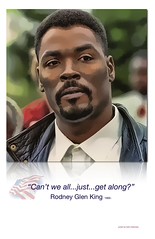
Rodney King: American Legend?

Rodney King poster
Rodney King poster (Photo credit: MarkGregory007)

An American legend has died.

Some may disagree with me, but how can Rodney King be called anything less than a legend?

When King’s horrific beating by police officers was caught on tape and publicized, I remember feeling a glimmer of hope. All along there had been cries of police brutality in the African-American community, but nobody would listen. The prevailing thought seemed to be that black people were just …bad people…and the good officers were only doing their jobs with  a people who had to be tamed.

No matter how loud the groundswell was from any particular community about what police were doing, nobody would listen. There seemed to be a “gentleman’s agreement” that what police did in black communities would remain in black communities, cries of injustice and excessive violence notwithstanding.

It made the black community feel invisible.

But with the video of King’s beating …I, and, I am sure, many others, felt like a just society would see. A justice system interested in justice would see; police departments all over the country would see; American citizens who were all too eager to write the black community off as troublemakers would see.

That belief spawned hope. Now it wouldn’t be “our” word against “theirs.” In a land where it was promised that there would be “liberty and justice for all,” justice would now come to the white officers who were caught on tape.

That was wishful thinking, however, and it really should be no surprise that after the officers were acquitted that there was a backlash. If it was that not even a video which showed what African-Americans had talked about for so long that would shake the foundations of excessive force so often used by police on African-Americans, then what would work?

King’s beating represented a raisin in the sun, a raisin of hope which exploded in a thousand fragments as that hope was dashed.

King didn’t set out to become a legend, but what happened to him thrust the issue of police violence, police brutality, into the spotlight. He became a legend by default. What happened to him, and how the justice system really ignored what was on that tape, became fodder for those whose social justice focus is police brutality. I am not quite sure how much progress has been made, but for certain, the awareness of what happens on the streets with too many citizens and police officers was heightened by King’s unfortunate experience.

Lots has been said about King’s demons. He never did really get his life under control if media accounts are to be believed. Drugs and alcohol were constant companions, and he was able to squander millions of dollars awarded to him after his beating. Everyone knows about that.

But what we may not know, or may not want to admit, is that King is a part of the American fabric, a thread in the cloth that nobody wanted in the cloth, most especially powers that be that have a vested interest in protecting the status quo.

King’s beating, and the subsequent acquittal of those officers, made a dent in a long-sanctioned system of police brutality, and that really does make him a legend.

A candid observation …