Making it In Spite of and Not Because Of

Lincoln Submitting the Emancipation Proclamati...
Lincoln Submitting the Emancipation Proclamation to His Cabinet (Photo credit: Marion Doss)

Martin Luther King wrote in 1964 that although President Abraham Lincoln signed the Emancipation Proclamation and the Civil War had been won for the Union, “there was not a just peace. Equality had never arrived.”

And still, equality hasn’t.

King, in his introduction to Why We Can’t Wait wrote that “Negroes were with George Washington at Valley Forge…the first American to shed blood in the revolution which freed his country was a black man named Crispus Attucks.”  King wrote that one of the team who designed the capital of this nation was a black man, Benjamin Banneker…”

“Wherever there was hard work, dirty work, dangerous work – in the mines, on the docks, in the blistering foundries – Negroes had done more than their share…”

And still, no justice, and little respect.

There can be little doubt, as we watch the goings on in the Trayvon Martin case, that the struggle for African-Americans to get justice in this country is still not over. In this particular case, race is not the only issue; Florida’s “stand your ground” law is equally culpable in having created the mess with which the Martin family is facing. Yet, there is a seething rage among blacks and an uncomfortable acknowledgement among whites that if the shooter had been black, and the victim white, the story unfolding would be vastly different.

I have long come to understand that blacks have made the gains we have in this country not because this is America but in spite of the fact that this is America. The presence of structural and institutional racism, even in the absence of stark and obvious racism, has made every step African-Americans have taken very difficult, and yet, African-Americans have pressed on. We have used the United States Constitution even though that document was never meant to secure or guarantee our freedoms or even our right to be here.

The parents of Trayvon Martin are to be commended, because they are standing on their constitutional rights and are demanding justice.  Interestingly, even when the United States Supreme Court has made rulings that should have made life easier and more just for African-Americans, there has been concerted effort to delay honoring the high court’s ruling; after Brown vs. Board of Education, many white school districts closed their schools rather than integrate.

Yet, African-Americans pressed on for justice, just as Trayvon’s parents are pressing on.

It would be such a relief if these types of struggles were over. It would be such a relief if race didn’t still have a seat front and center in so much of American life, but it does, and we refuse to acknowledge her presence and her power in our society.

Kudos to Trayvon Martin’s parents, who refuse to give up. When everyone takes off their hoodies, I only hope that they don’t abandon their determination to make sure race-based injustice doesn’t continue to be a staple of American life. It is so past time for our story to change.

A candid observation …

Dr. King and the Trayvon Martin Case

Dr. Martin Luther King at a press conference.
Dr. Martin Luther King at a press conference. (Photo credit: Wikipedia)

This week, as I listened to different people, primarily white, urge people to “trust” the justice system, and to “wait” for the justice system to work in the Trayvon Martin case, I found myself wanting to cover my ears from the din of useless noise.

Useless noise is exactly what it sounded like, this plea for African-Americans to wait for the justice system to work, because the system has so seldom worked on behalf of black, brown and poor people in this nation.

In his Letter from a Birmingham Jail, Dr. Martin Luther King talks about “the law,” and how there are just and unjust laws. It seems that white clergy were urging Dr. King to obey the law and to “wait for the justice system to work.” Dr. King pushed back, saying that “there are some instances when a law is just on its face and unjust in its application.” I thought of the “stand your ground” law that is apparently protecting accused shooter George Zimmerman from being arrested. Truly, that law is just on its face, but it seems like it was unjustly applied in this case.

Dr. King talks about what is “legal,” in his discussion of just and unjust laws. The white clergy were accusing Dr. King of breaking the law, and therefore doing something illegal. Again, Dr. King pushed back, writing, “We can never forget that everything Hitler did in German was legal and everything the Hungarian freedom fighters did in Hungary was “illegal.” It was “illegal” to aid a Jew in Hitler’s Germany,” he wrote. If, I thought, Trayvon was the aggressor in this case, according to Florida law, he would have been breaking the law, and would have put himself in the position of having to be fought off.

But it just doesn’t seem that that scenario is correct…and it seemed, as I listened to white people urge others to be calm and obey the law and let the justice system work, that they were more concerned with “law and order” than they were, or are, concerned with justice. Said Dr. King: “the white moderate who is more devoted to “order” than to justice, who prefers a negative peace which is the absence of tension to a positive peace, which is the presence of justice, who constantly says, ‘I agree with you in the goal you seek, but I can’t agree with your methods of direct action,’ who paternally feels that he can set the timetable for another man’s freedom, who lives by the myth of time and who constantly advises the Negro to ‘wait until a more convenient season,” …is frustrating. He said people of good will who have such shallow understanding are more frustrating than people of ill will who have absolute, total misunderstanding.”

It is apparently very difficult for white Americans to understand the “souls” of black people in this nation, who have been so battered, and not bettered by, the justice system. There are reasons why the rage is so obvious about young Trayvon’s shooting and Zimmerman’s non-arrest. The reasons reach far back into our history; many of us have relatives who were abused by a justice system which never intended to exhibit justice toward them or their cases. And now, here in the 21st century, we find that really not all that much progress has been made.

Roland Martin, CNN commentator, said that if there are no protests, we cannot hope for justice. Had it not been for the bravery and tenacity of Trayvon’s parents, this case would have been swept under the rug with no mention; another young black male would simply have been buried…but Tracy Martin and Sybrina Fulton, Trayvon’s parents, sounded the battle cry, blew the trumpet, if you will. Their refusal to let their son die in vain reminded me of how Emmett Till‘s mother, Mamie, catapulted the national shame called lynching to international attention when she refused to let her son’s death be ignored.

Dr. King, in Letter from a Birmingham Jail, wrote, “Oppressed  people cannot remain oppressed forever. The urge for freedom will eventually come.”  He acknowledged that “few members of a race that has oppressed another race can understand or appreciate the deep groans and passionate yearnings of those that have been oppressed, and still fewer have the vision to see that injustice must be rooted out by strong, persistent and determined action.

Dr. King’s words, written in the mid 1960s, are just as appropriate today. The demonstrations against what appears to be gross injustice in the Trayvon Martin case must continue …or else, there will be no justice.

A candid observation…

Trayvon Martin Case: Something is Very Wrong

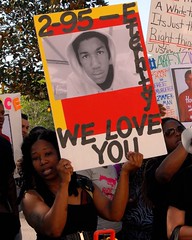
Trayvon Martin Protest - Sanford
Trayvon Martin Protest - Sanford (Photo credit: werthmedia)

I keep thinking that there is one point the Sanford, Florida police department apparently has not fully considered: that if George Zimmerman had not followed Trayvon Martin, and had not exited his vehicle to approach the young man, Trayvon would be alive today.

It still feels like Trayvon was standing his ground. He was being followed by, and then approached by someone he did not know, who had a gun. It is reasonable to believe that the young man, frightened, defended himself against what he thought was a sure and present danger.

How come that possibility has seemingly not been advanced by the police department? In all the press conferences I have seen, not once have I seen the police say that they are considering that possibility as well.

What we have, why this case has brought out so much rage, is another example of what appears to be the willingness on the part of law enforcement to  devalue the life of a young African-American– again. Florida and indeed many states have a long history of injustice when it has come to incidents involving whites and blacks, with white people being given the benefit of the doubt and being let free. Black people have historically been discarded, devalued, as it were, and there is a sense of rage based on a history of injustice.

Isabel Wilkerson, author of the book The Warmth of Other Suns, wrote an excellent piece for CNN yesterday, describing the historical wrongs done as concerns whites and blacks as concerns crime committed and justice served or not served. That injustice, or the fear of injustice, prompted many African-Americans to  leave the South, to migrate to the North and to the Midwest, in search of  jobs, surely, but also in search for a place where they might get more justice.

That has not necessarily been the case, and everyone who is an African-American knows it. The fact that George Zimmerman has not been arrested, and the apparent fact that the possibility that Trayvon Martin could very well have been standing his ground, promotes anger that comes from an historical reality. It is not at all surprising that details about Trayvon’s apparent multiple suspensions from school, and about how traces of marijuana were found in his book bag. There has to be a reason for what Zimmerman did and how he did it; how better to do that than to create an image of a troubled, violence-prone teen?

But in spite of whatever details about Trayvon are released, it still doesn’t assuage the anger of people who are wondering why – again – it feels like a white man will get away with killing an African-American. The details about Trayvon do not erase the apparent fact that the young man was apparently approached by Zimmerman, in spite of the fact that he had been told not to do that. The details do not justify Zimmerman getting out of his car and apparently approaching Trayvon.

Something is wrong here, and lots of people know it.

A candid observation…

U.S. Supreme Court Doesn’t Inspire Confidence

I find that I do not have much confidence at all in the justice system of this nation. I have little confidence in police and other law enforcement officers, and I don’t have much confidence in the courts, including the United States Supreme Court.

When I was little, my second grade class was visited by “Officer Friendly.” We were taught that the police were the “good guys,” and we never had to worry if we were in trouble. That gave me, a little kid, a lot of confidence and a sense of security.

But while there are good police officers, what I found over the years is that police officers were often not the friend of African-Americans, and I found that the courts were often not so interested in being fair to African-Americans. In spite of the American democratic and judicial ideal of one being “innocent until proven guilty,” what I found as I read and studied was that African-Americans were often considered guilty and not worthy of proving innocence.  All-white juries, I read, convicted black people on the smallest of crimes and also on major crimes for which there was little to no substantiating evidence.

This America upheld or at least ignored Jim Crow, was reluctant to intervene in cases involving race, and would not pass a law outlawing lynching.

My heart was seriously broken, though, when in a sermon Rev. Dr. Jeremiah Wright preached that in the Dred Scott case, Chief Justice Roger Taney ruled that “there were no rights of a black man that a white man is bound to respect.”

I felt tears coming down my cheeks in spite of myself.

In the Dred Scott case, the U.S. Supreme court also ruled that the Bill of Rights didn’t apply to African-Americans. “If it did,” the Court ruled, “African-Americans would be able, in full liberty of speech in public and in private to hold public meetings upon political affairs and to keep and carry arms wherever they went.”

That was in 1856. In 1883, in Pace v. Alabama, the nation’s high court upheld an Alabama law which forbade interracial marriage. Such a marriage could land the offenders from two to seven years in prison. This ruling was overturned in Loving v. Virginia in 1967.

We all know about Plessy v. Ferguson, which ruled that there was such a thing as “separate but equal” when considering public institutions, a ruling which was overturned by Brown v. Board of Education in 1954. In Cumming v. Richmond, in 1899, three black families in Richmond County, Virginia, went to the court for justice when the closing of the area’s only high school for black students were closed. They wanted their children to be able to finish their education at the white high school, but the Court snubbed them, and said that if there were no suitable black school in a given district, African-American students would have to go without an education.

The more I read, the more I am floored, and that child’s disappointment with the reality of American as opposed to the myth of America comes back. The Affordable Health Care Act is now before the Court, provisions of which will help many of this nation’s citizens, but I have no confidence that the Court is interested in upholding or even establishing justice or equity. This nation’s high court does not seem to be on the side of “the least of these.” In Lum v. Rice, in 1927, a nine-year old Chinese girl, Martha Lum, faced the coldness of the court as concerns race. Congress had passed the Oriental Exclusion Act in 1924 to control the number of immigrants from Asia, but Asians already living in America were American citizens.

The problem was that there were not enough Asians for them to have their own school; strict separation of races in public schools was the law of the land, and so Lum’s family  appealed to the Court to attend the nearby white school. The Court said no.

Well, I don’t see where the justices on the Court today are any more inclined to lean toward “justice for the masses” than they were in the 19th and 20th centuries. I don’t feel that the justices’ definition of justice intersects with the definition of justice of so many Americans. It feels like the Court is interested, as it has always been interested, only in protecting the power, position and privilege of the status quo. Equity among the people is not an American value. “All men are created equal” does not mean every man, and this is not a country that espouses and pushes “liberty and justice for all.”  To believe in equity and/or equality, liberty and justice for all, is to lean dangerously to the Left, I am learning, putting oneself in position to be labeled a Socialist, or worse.

I am holding my breath on this Court’s ruling on the Affordable Health Care Act, but I won’t hold it long, I am afraid.

This Court has done little, unfortunately, to make me trust it or its intentions.

A candid observation…

Where are the GOP Candidates?

Did I miss it?

A true American tragedy has happened. A young, unarmed teen has been shot dead, and the shooter has not been arrested. The parents are anguished, the nation, black, white, and brown, is outraged, and I haven’t heard the GOP presidential candidates, with the exception of Newt Gingrich, say a word about it.

There has not been a word from GOP frontrunners Mitt Romney or Rick Santorum about it.

Gingrich, while defending the “stand your ground” law that Florida follows, has said that the case is a tragedy and has said that a full investigation is warranted. He has even said that the “stand your ground” law “may not apply in this case.”

So, are we to assume that the other three candidates, Santorum, Romney and Paul, do not care about this case, about what appears to be a true American tragedy? Have they no room in their hearts to at least express concern and care for young Trayvon’s parents?

Santorum raised the biggest stink about contraception. He has been vocal about the “attack on religious freedom,” but is he really so out of touch as to not see the vestiges of  injustice in this case?  Mr. Romney has spent literally millions of dollars to attack his GOP opponents; is there not a thread of outrage in him that would encourage him to attack or at least address a justice system that has allowed a gross injustice to occur?

This type of injustice as concerns African-American men, is not new. It is part of America’s reality. Any president, or one who wants to be president, is surely aware of that…and ought to have the chutzpah to speak out against it. After all, if Romney or Santorum were to be elected, he would have to be president of all of the people, not just of their base.

Am I wrong?

Thank goodness for the groundswell of outrage all over the country.  From what has been presented to us, there are serious questions about what happened. What seems sure, though, is that Trayvon Martin should not be dead,and George Zimmerman ought to be answering for his behavior.

Thank goodness, too, that we are seeing the capacity of Santorum and Romney to be willing to be president of all of the people, and their capacity to take a stand on a difficult issue: racism and the justice system in America.

These two men are not presidential. The president of the United States has to be the president of all of us. He (or she) has to have the courage to stand up and against what appears to be wrong. At the least, he or she has to be able to relate to Americans who are hurting, like Trayvon’s parents.

President Obama, who has walked carefully over the minefield called race and racism in America, has spoken out, saying that if he had a son, “he would look like Trayvon,” but he said he wanted to respect the investigation of the case,  both national and local. That was the right thing to do, the right thing to say. That as presidential.

However,neither  Santorum, Romney nor Paul has shown compassion or backbone, not in this instance.

It’s a significant revelation. It is a telling revelation. It is a troubling revelation.

A candid observation …