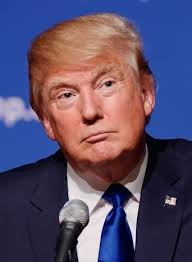
The Definition of Patriotism

American-flag-America

I had a Twitter conversation with a Donald Trump supporter that has left me puzzled.

Donald Trump, she said, is a patriot.

I had been complaining that Trump is not civil; civility matters to me. She acknowledged that he was not so civil but that he was a patriot. The country was in tatters and he was going to make things right again.

So, I’m puzzled. Is patriotism the same thing as racism? Is patriotism the same thing as isolationism? Is it synonymous with Islamophobia? I have no doubt that Trump loves America, but it is the flavor of his love that is making me question the definition of patriotism. Is President Obama not a patriot? Are the non-native born American citizens, especially those who have fought for this country, not patriots?

The Merriam-Webster Dictionary defines patriotism as, simply, love for one’s country.

Trump is, by definition, a patriot. I was combining my idea of patriotism with my idea of civility. They are not synonymous. Trump, to me, is an uncivil patriot.

Patriots do not have to care about how they treat fellow Americans. What they do have to do is be against “the enemy,” wherever and whomever that enemy might be.

Donald Trump is not a patriot merely because he wants to bomb ISIS and make NATO members pay what they’re supposed to pay for. I hope he or someone can get rid of ISIS and all terrorist groups, including the domestic ones like the Ku Klux Klan.  And I hope that if he is elected, he will be able to get member nations of NATO to pay what they are supposed to pay.

Where I get confused is how he, as a patriot, can openly ask Russia, a long-time enemy of the United States, to hack into Hillary Clinton’s emails. If they hack into her emails, can’t they and won’t they hack into other documents that are vital to American security?  All this courting of Russia doesn’t feel patriotic to me. It feels troubling.

So, can one be a patriot and invite the enemy into its most private spaces? Isn’t Russia trying to regain its role as a top world power? Isn’t inviting Russia to hack an American politician’s email account kind of treasonous? Trump seems to trust Russia’s Vladimir Putin quite a bit. What is the basis of and for that trust? What has Putin done to show that Russia is America’s ally?

I am trying to understand. Someone help me. Because I am obviously missing something. What is a patriot? Donald Trump is a patriot because he loves his country, yet he questions the patriotism of President Obama and others whose foreign policy is different from his.

Patriotism seems to be a liquid concept if I go with the love for Trump as a patriot. It’s confusing.

A candid observation …

Trump is a Voice for the Frightened


When I was invited to preach at a white Episcopal church in Charles Town, West Virginia, the lead priest of that congregation called me to kind of coach me on how to approach the congregation.

Donald Trump

I was/am an educated African American woman. Her congregation was highly educated as well, but there is an issue of which I needed to be aware.

“They’re very sensitive about being talked down to,” she said, going on to explain that many white Southerners feel marginalized and put down by the “elites.” The elites were those with a lot of education, white people, she said, who they felt were always thinking that Southern white people were inferior, uneducated and, frankly, beneath them.

They were thus sensitive to being talked to in a way by an educated person which spewed that sentiment, and they were equally as sensitive about being called racist. Most of them hotly denied that they were racist, and would react badly if anything in my sermon got to that space of emotional pain that many white people, Southerners and Northerners as well, have carried for decades.

I was grateful for the priest’s “warning,” and worked very hard to make sure what I preached about – even though it was about racism – was not in any way an attack or a put down. Racism, I preached, was an aberration of spirit, something which Americans carry without even thinking about it. I worked very hard to illustrate the connectedness of all human beings, the ways in which we are the same regardless of color, before I got into the meat of the message, describing the damage racism does and has always done. It is America’s disease, I preached – not a new sentiment at all – but one which America has yet to acknowledge. And I tied all of what I was preaching about with the story of little Ruby Bridges, the little black girl who for a year sat in a classroom in New Orleans all by herself because racist people would not let their children be near her. I have a gift as a storyteller and worked the story so that the people could find the commonality of experience, the commonality of pain, the commonality of what it is to be a parent.

I think of that Sunday often. Charles Town is the city where John Brown was hanged for inciting an insurrection. It is rich in Southern history, a history which is rich with the stories and experiences of a culture which is racist but which ignores it in the hope of the reality of racism going away. America wants to keep its dirty little secret – which is not so little at all  and which is definitely not a secret- hidden away in a closet, and believes that if the secret stays in the closet, all will be well.

That belief, however, has always been wrong, and the proof that not talking about racism makes it go away is pushing up in the midst of this presidential election cycle. Donald Trump is feeding those who, like the Episcopal priest told me, are sensitive to being called racist and uneducated. A memo circulated by the Trump campaign vowed to concentrate on that group of people. (http://dailycaller.com/2016/08/06/trump-campaign-memo-primary-strategy-was-to-provide-safe-space-for-voters-called-bigots/) They are the ones who are screaming loudest about the “elite” people, those, they believe, who have been in power for too long. Their voices, beliefs and needs have been marginalized, ignored and cast aside for too long, in the quest of being politically correct, and being politically correct has meant “not talking about” racism and how the government, they believe, has done too much for black, brown and poor people, at the expense of white people.

The belief in white supremacy has driven American culture from its inception. After Reconstruction, whites who believed in their supremacy and resented the perception of blacks that they were equal with whites and therefore were owed the same rights, put Jim Crow into effect, effectively thrashing the gains made by black people, especially their right to vote. They believed then and many still do that America is a “white man’s country.” That doesn’t make them racist, they believe. That just makes them American.

No matter what, they have always been able to rely on their skin color to keep them in the running for the American dream, but globalization, making it possible for more people of color to invade what is supposed to be a white space, has weakened their status. They not only see more people of color coming into their land, they read or have heard the reports that by 2043, white people will be the minority in the United States. (https://mic.com/articles/106252/the-year-white-people-will-become-a-minority-in-america-has-been-declared#.TCKjBGUh9)

Donald Trump is speaking to a group of people who are angry, who have been marginalized by a government they think has been too big and too willing to embrace people of different races and religions, and who are seeing their version of white supremacy get more and more watered down. What they want “back” is the America where their status was secure.

That’s not going to happen.

But their fear is something Donald Trump knows. The group to whom he is speaking is vulnerable to his rhetoric, but the truth of the matter is that whites who are educated and who have gained pieces of the American dream are worried as well. “The marginalized” is not so small a group as many would like to believe. America is changing, and not many white people like it at all. Trump knows that, too – that whites of all classes are worried.

And so he is plowing through this campaign saying whatever he wants, challenging what has “always been,” promising that he alone will change the trajectory of a world which has not stood still, white supremacy notwithstanding.

And in his quest to speak to the hearts and concerns of those who feel abandoned and ignored, he is winning.

A candid observation …


What is a Joke?

At the height of the Democratic National Convention, Donald Trump, our Republican nominee for president, called a press conference, and during that press conference, he invited the Russian government to hack into Hillary Clinton’s email account.

He said that if the Russian government could find 30,000 missing emails, emails that Hillary Clinton said she erased, that the American press would probably “mightily reward” them. (http://www.nytimes.com/2016/07/29/world/europe/russia-trump-clinton-email-hacking.html)

His statement was shocking and troubling, and the press, as well as American government and security personnel, jumped all over it. Pundits tried to play it down; it was just “The Donald” being “The Donald,” practicing his craft of manipulating the press, as he so skillfully does. Any press, even bad press, is good, he believes. What better way to keep the spotlight on him, in light of what some might say is a fairly successful Democratic National Convention, than for him to say something outrageous?

But as the press and people who know government spoke out, Trump backtracked some, and said he was merely being sarcastic. And his friend Newt Gingrich, said that Trump had only been “joking.” (https://www.bostonglobe.com/news/politics/2016/07/27/newt-gingrich-says-donald-trump-was-joking-about-hillary-clinton-mails/vx5Ml4OXKJmfIcFMaDv6BK/story.html)

I’m confused. I thought a “joke” was or is supposed to be funny. Granted, the perception, understanding and interpretation of what is “funny” is left to the beholder, but there ought to be some thread of commonality, regardless of who is doing the interpreting, right?

The Merriam-Webster Dictionary says that a joke is “something said or done to cause laughter. : a brief story with a surprising and funny ending. : someone or something that is not worth taking seriously.” Good comedians are rare; they are capable of taking what we experience every day and making it funny. Their jokes make us laugh at ourselves, laugh at our habits and idiosyncrasies, laugh at our situations or even how we think. The best jokes, it seems, don’t make us look at someone who has a problem and laugh at them; at best, good jokes make us look at how we look at different people at laugh at ourselves.

But it seems that far too often in our world in general, and in our American world specifically, people say things that insult or put others down and when their words are found to offend, the immediate response is, “It was just a joke,” or “you can’t take a joke.”

Seriously?

When the mayor of a small town in Washington State called Michelle Obama a “gorilla face” and President Obama a “monkey man,” he said that it was just “playful back and forth banter.” (http://www.huffingtonpost.com/entry/washington-mayor-racist_us_55a71677e4b04740a3defd84)

Amy Schumer has been called on the carpet for saying disparaging things about Mexicans. She calls them “jokes.” Mexicans call her words hurtful, racist and offensive. (https://www.washingtonpost.com/posteverything/wp/2015/07/06/dont-believe-her-defenders-amy-schumers-jokes-are-racist/)

I personally hate the “n” word, but when an African-American is telling a story about some experience he or she has had with friends or family and uses the word, sharing an experience with which we as African Americans are all familiar, it is funny. But when a white person begins to use the word, not becoming immersed in a common, comical cultural experience but instead is standing outside looking in, the words sound judgmental, racist, and, frankly, inappropriate. A white person using the “n” word is never funny, and black people need to drop it, too. But there is a noticeable difference when black people are using it to describe black life, black experiences, black emotions and black pain.

But back to Donald Trump and his invitation to Russia to hack Hillary Clinton’s emails – where  is the humor? Where is the joke? What are we supposed to find amusing about a presidential candidate inviting a known enemy of this nation to commit espionage?

Am I missing something here?

It is a cop-out to say one was only “joking”  when his or her words have backfired. If President Obama gave a presentation and called Donald Trump some disparaging term that has obvious racist overtones, the airwaves would burn. When people have said things about Trump, say, for instance, about his hair, they haven’t had to back up and say they were joking. They weren’t.

And neither was Trump. He was speaking from his heart, just as too many people do who say things that offend other people, especially along racial, ethnic and sexual lines. Calling someone a name, like too many have done, is not funny. Inviting an enemy to compromise your own nation’s security…is not funny, either.

Donald Trump was not joking and you were not being sarcastic. That’s what makes what he said so troubling, and even more troubling is the fact that his hard core followers do not care.

But many more do care, Mr. Trump. Many more do.

A candid observation …


When Black People Don’t Vote

The other day, I was going into a library and as I approached the door, a young man with a clipboard approached me, asking if my voter registration was up to date. As I assured him it was, my ears perked up when the other gentleman with a clipboard asked an African-American woman the same question I had been asked, and she snapped, “Yeah. Naw. I don’t vote!” And at that, she stormed into the library. I followed her and she grumbled to a child who was with her, who may have been her grandchild, “how dare them ask me if my registration is up to date! They don’t question me! If I want to vote, I’ll vote.”

I didn’t know if that meant she had a voter registration card and was just miffed that someone asked her if her information was up to date, or if she really planned not to vote. I don’t have the answer to my own question, but this I do know: it does something to me when I hear black people say they are going to vote.

Last year, I visited Selma. I walked across the Edmund Pettus Bridge. As I walked, I remembered reading what happened on that bridge, how black and white people were beaten back by white police officers who beat them, injuring many, including Congressman John Lewis, who was a young man at the time.

As we walked across that bridge, I remembered thinking how chaotic and scary that day or that project had to have been. The bridge is not large; it is not long and it is not wide, and yet, thousands of people, tired of having to take literacy tests given, many times, by people who could not read themselves. I thought about how those people kept hitting against the Evil called white supremacy, being beaten, imprisoned, having their houses burned down by white people, many of who were law enforcement officers…I thought about how people stayed the course and risked their lives and much more, just to get black people the right to vote.

And yet, some people say they will not vote.

I have heard young people say voting doesn’t matter, or, more specifically, that their vote does not matter. I have heard other people blame God, or give God credit, for their not voting. One woman, when I was registering people before the 2008 election, said God told her not to vote, that the only One she had to answer to, was God. No, she said, she would not be voting.

Her statement confused me and bothered me, just as this woman the other day at the library confused and bothered me, and, frankly, made me angry.

I remember growing up, when we kids would do something wrong that made us look like the selfish kids we were, my mother saying, “I’ve done (and she could list the things she had worked and sacrificed for) for you …and this is the thanks I get?

Those words gripped me as I grappled with this woman’s reaction to the question about being up to date with her voter registration information, and her declaration that, “no,” she would not be voting.

How can anyone of African American descent say that?

For many, there is disappointment that Hillary Clinton is the presumptive nominee. They are disappointed because they feel her message was supported by the media, though they feel that her message and candidacy was supported at the expense of Bernie Sanders. Others are angry at her because she supported policies of her husband, former President Bill Clinton, that were responsible for many black people being in prison today for either petty crimes, or crimes they did not commit.

To be honest, I am not wild about Hillary being in the White House, either. I don’t think she is any worse than any other candidate, but I am just not inspired by her campaign promises and rhetoric.

But though I am unimpressed by what she is saying, I cannot choose to skip this election and my by absence, give more votes to Donald Trump. Trump and the Republicans represent the racism, overt racism, that our ancestors fought to be rid of. Trump is a bully,and a narcissistic racist who is appealing to the guy wrenching fear and anger of a group of people who want him to “make America great again.”  I don’t think we as black people understand fully about how being present in the political arena and exercising our right to vote is about the best way to make sure white supremacy is held at bay.

I am hoping black people who are planning not to vote will rethink their plans. Black people don’t win by withholding, or rejecting  their privilege to vote. We have got to be present, in the middle of the cocktail party, so to speak, to make our voices heard and to not let the poison of white supremacy spread across these United States like a toppled jar of non-washable ink. Our ancestors, I keep thinking, must be weeping in their divine sleep, screaming screams that cannot be heard, saying, “No!”

We have come too far, but the powers that be are working to undo those changes, slowly, persistently, and financially. If we don’t vote, we contribute to Trump’s victory. But listen up: We needed the right to vote.  Even if you hate Hillary Clinton, there is or will be more chances to perhaps get people in high places so that the gains we’ve made will not be completely eroded by a group of people who “want their country back.” I don’t know what all that means, but it feels like something that will be designed to break our backs. They are gearing up for the victory of a man who thinks of no one but himself; if we let him in, we suffer; the gains we’ve made will be done away with.

And our ancestors will weep again.

A candid observation..


When the Women Rise Up

In light of the tragedy of the past week, one thing is standing out.

It’s the women. Women, aching, crying, concerned and committed, are standing up and speaking up and speaking out.

Diamond Reynolds, the girlfriend of Philando Castile, had the presence of mind to record the interaction between herself and a gun-holding police officer, doing a “live” recording that people could see immediately. It was phenomenal to watch. That she had the presence of mind to do that spoke volumes about her strength. As her boyfriend lay dying, as her four-year-old daughter sat in the back seat of the car, terrified, at times crying, and finally trying to comfort her mother, Diamond forged ahead, through her pain and terror, to tell a story she knew needed to be told.

Then there is the African American female cop who lives in Warrensville, Ohio who watched the video of Alton Sterling, a video in which she saw Sterling shot multiple times at point blank range, and this woman, a police officer, a woman, a mother …and an African American, spoke out. (http://www.ajc.com/news/news/national/how-dare-you-ohio-police-officer-nakia-jones-voice/nrtMG/)

Watching them, my mind went back to when Emmet Till was murdered – lynched – in Money, Mississippi after he  allegedly flirted with a white woman. He was visiting relatives and didn’t know …and was young and arrogant enough to disregard …the “Southern” way of life, which included the prohibition of a black man to pay attention or to “disrespect” a white woman. What that “disrespect” was was left entirely up to the white people, primarily white men, who made the call.

Emmett, only 14 years old at the time, was dragged from his uncle’s house in the middle of the night by relatives of the white woman who made the accusation against Till. His murderers beat him nearly to death; they gouged out one of his eyes, shot him in the head, and then used barb wire to tie his body to a cotton gin fan and threw his body into a river.

It was a horrific death, but those kinds of murders of black people were common in the South, and hardly anyone ever went to jail or prison – or even got charged, for that matter. It was the intent of the good ol’ boys that the narrative be that Emmet had just disappeared. But three days after his murder, his body washed up and was discovered. The authorities reportedly just wanted to hurriedly bury Emmet, but his mother, Mamie Till, who by now had been contacted about the disappearance and now the death of her son, refused to let them bury him. She headed from Chicago to Money, Mississippi, Emmet’s body lying in a funeral home waiting to be identified. He had decomposed so much that it was difficult to identify him, and the stench from his decaying body was so bad that Mamie could smell him when she got off of the train. But she went to that funeral home and demanded to see her son. She was able to positively identify him by a ring he had on his finger. She decided she would take her boy home, as expected, but what people didn’t expect was for her to insist that his coffin remain open so that the “world could see what they had done to her boy.”

Her decision was bold. It was courageous …and it was an action that stirred the complacency of people – white especially, but black as well – to sit up and notice an evil that was so much a part of American life that it was nearly taken for granted. There was some personal risk, one might assume, for Mamie, but danger to her was not her concern. She was tired. She had had enough. She hated racism and white supremacy. She had raised a good boy in a difficult time …and now, racists had killed her boy and wanted to cover it up and act like it was no big thing.

It wasn’t going to happen.

Her spirit was one of fire. Her spirit, like the spirits of Fannie Lou Hamer and Ella Coleman and Mary McLeod Bethune, and Rosa Parks …and so many women we usually mention but don’t give enough credit to, became a driving force in the continuing effort to take the covers off the shenanigans practiced by racist people who took stock and had confidence in their ability to mess over black people and get away with it. In these last few years of horrific police violence against black people, it has been women who have stood up and spoken up, saying, in essence, “no!” Sabrina Fulton, mother of Trayon Martin,  stood up. Lucia McBath, mother of Jordan Davis, stood up. The mother of Henry Green in Columbus, Ohio, Adrienne Hood, is standing up. There are more, and their impact cannot be underrated.

Mamie said, “no.” She said no, as did the women named here and so many others. Men in African American culture have done some amazing things, but it is the women who are standing out for me. And now, it is women, again, who are standing up. Nakia Jones, a police officer, could lose her job for standing up and saying that police who have race issues should not be cops. She said it and she said it with passion. She said that what she saw in the shooting of Alton Sterling was wrong,  and she said it boldly.  Diamond Reynolds said …no. If her boyfriend was going to die, she was determined that the world would know how it happened.  They said no and because of their courage, the world is having to look at things they have tried to run and hide from for decades.

I think there should be an award, a “Mamie Till Award” given to women who stand up and speak up with little regard to the risk to their own comfort.  While few people have any confidence at all that the police officers who killed Sterling and Castile, there is one thing most people have to admit: that because of the courage of women,  this world is a little bit more aware today than it was at the beginning of the week.

A candid observation …


http://www.history.com/this-day-in-history/the-death-of-emmett-till